

Trading
Explore a wide range of markets with competitive pricing, deep liquidity, and advanced trading tools.
Learn More 
Platform
Trade seamlessly with TMGM's powerful platform, built for speed, precision, and a superior trading experience.
Learn More Trading Platform
Academy
Learn the fundamentals of trading with beginner-friendly resources, including guides, webinars, and market insights.
Learn More News & Analysis
Get real-time market updates and expert analysis to stay ahead of trading opportunities
Learn More News & Analysis
About
Learn what sets TMGM apart — our global presence, regulatory strength, and commitment to innovation in trading.
Learn More Why Choose TMGM
Sponsorship
Below 1.1100: EUR/USD price forecast points to renewed downside as US Dollar strengthens
- 1.1138 in focus as EUR/USD slips and the US Dollar leads its peers.
- Persistently high US core CPI prompts traders to increase bets on a hawkish Fed.
- Christine Lagarde to be replaced as ECB President by Klass Knot.
EUR/USD is down 0.2% at around 1.1138. The Euro (EUR) is losing ground against the US Dollar (USD) in Wednesday’s European session. Supporting the US Dollar and weighing on the pair are concerns that the Federal Reserve (Fed) could embark on an aggressive monetary tightening cycle to curb inflationary pressures that continue to accelerate.

US Dollar Performance Today
Today’s percentage moves in the US Dollar (USD) against the major currencies listed are set out below. The Swiss Franc recorded the largest loss against the US Dollar.
| USD | EUR | GBP | JPY | CAD | AUD | NZD | CHF | |
|---|---|---|---|---|---|---|---|---|
| USD | 0.22% | 0.21% | 0.16% | 0.23% | -0.03% | 0.24% | 0.47% | |
| EUR | -0.22% | -0.01% | -0.05% | 0.01% | -0.26% | 0.02% | 0.24% | |
| GBP | -0.21% | 0.01% | -0.04% | 0.02% | -0.24% | 0.04% | 0.26% | |
| JPY | -0.16% | 0.05% | 0.04% | 0.07% | -0.19% | 0.07% | 0.30% | |
| CAD | -0.23% | -0.01% | -0.02% | -0.07% | -0.26% | 0.00% | 0.23% | |
| AUD | 0.03% | 0.26% | 0.24% | 0.19% | 0.26% | 0.28% | 0.50% | |
| NZD | -0.24% | -0.02% | -0.04% | -0.07% | -0.01% | -0.28% | 0.23% | |
| CHF | -0.47% | -0.24% | -0.26% | -0.30% | -0.23% | -0.50% | -0.23% |
Percentage movements between major currencies appear in the heat map. Select the base currency in the left-hand column and the quote currency in the top row. To read USD (base)/JPY (quote), for instance, start with the US Dollar in the left-hand column and follow that row across to the Japanese Yen. The intersecting cell gives the percentage change for that pair.
At 102.51, the US Dollar Index (DXY) reaches a new high for almost four weeks during European trading. The index measures the Greenback against six major currencies.
Following October’s stronger-than-forecast United States (US) Consumer Price Index (CPI) release, financial markets have begun to price in a December interest rate increase of 50 basis points (bps), according to the CME FedWatch tool. The probability remains low, however, at around 13.5%.
In a note, Deutsche Bank strategists observed that the “monthly core CPI print for October was above consensus at +0.30% (vs. +0.2% expected).” The bank further noted that “it was the third consecutive month with core CPI at +0.3%, and if you take those three months together, the annualised pace for core CPI is running at +3.75%.” On the persistence of that strength, the bank said “that’s the fastest pace on that measure since April 2024, so it made it increasingly difficult to dismiss this as a blip.”
Turning to the headline figures, the bank emphasised that “meanwhile, the headline CPI numbers were faster still, with monthly headline CPI at +0.35% (vs. +0.3% expected), with the 3-month annualised pace at +5.72%.”
A leadership transition at the European Central Bank (ECB), meanwhile, is expected to sustain high volatility in the Euro.
ECB succession: Klaas Knot prepared to respond to future crises
A Financial Times interview with Dutch central banker Klaas Knot has drawn attention from Rabobank. A leading contender to succeed ECB President Christine Lagarde, Knot highlighted the Governing Council’s crisis-response credentials, stating that “If circumstances require it, we will not hesitate to take action.” Rather than a return to “50bps rate hikes due to geopolitically driven inflation,” analysts interpret his comments as addressing the opposite situation: a future European crisis “of a different nature.” Against that backdrop, Rabobank noted that Knot “would not rule out developing another, more tailored instrument,” suggesting that new policy tools could be introduced if conditions worsen again.
1.1138: EUR/USD Technical Outlook
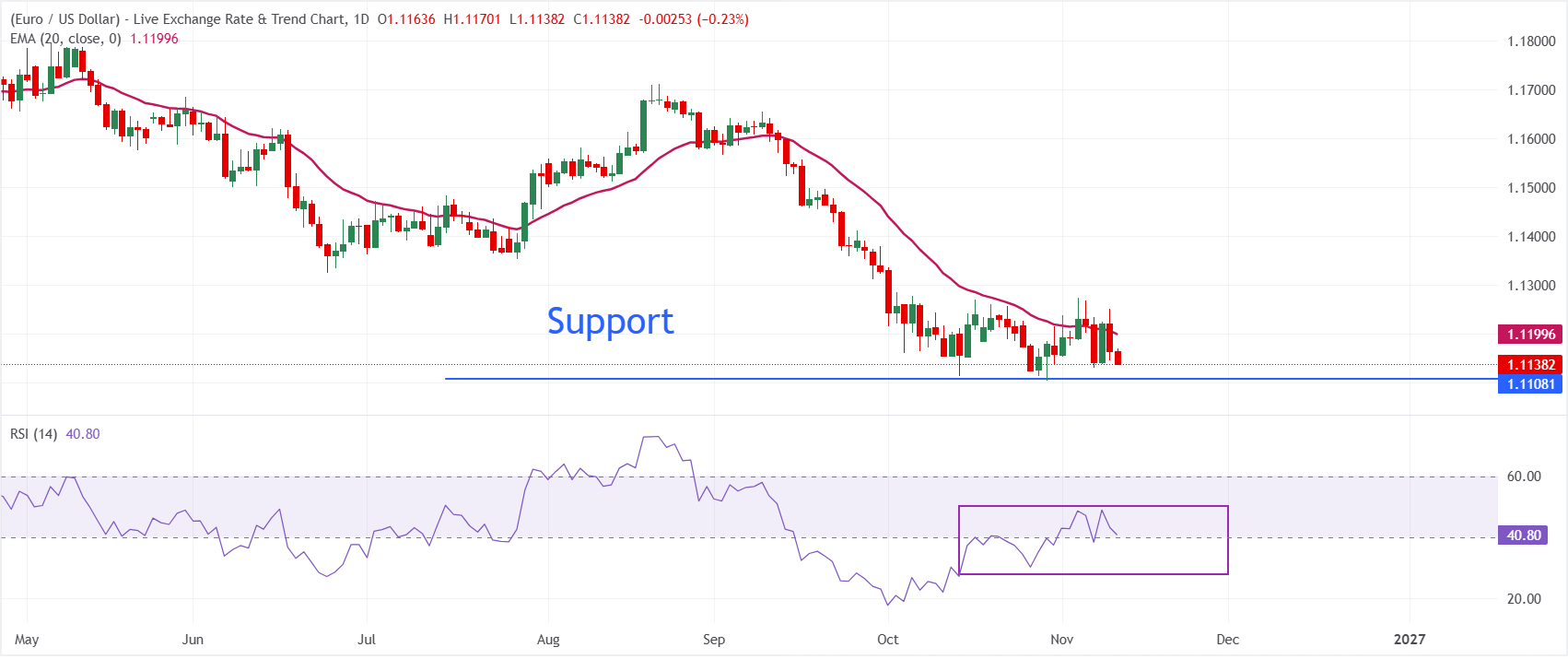
At 1.1138 on the daily chart, EUR/USD retains a mildly bearish tone. The pair is trading below recent closing levels and just beneath its 20-day exponential moving average (EMA) of 1.1200, now an immediate obstacle.
Earlier oversold conditions this month have eased, but the 14-day Relative Strength Index (RSI), around 41 and below the neutral 50 mark, still signals prevailing downward pressure.
Immediate support lies at the recent 1.1104 low. A breach would leave 1.1000 exposed. Conversely, a rebound towards the 20-day EMA support zone around 1.1200 would offer an initial sign of stabilisation. To reduce the prevailing bearish bias and allow a wider corrective recovery, the pair would need to hold above that level.
(The technical analysis of this story was written with the help of an AI tool. Know more.)
Economic Data Indicator
Consumer Price Index excluding Food & Energy (MoM)
The Consumer Price Index (CPI) tracks inflationary or deflationary trends by periodically adding up the prices of a representative basket of goods and services. Compiled monthly, the data is published by the US Department of Labor Statistics. The month-on-month (MoM) figure compares goods prices in the reference month with those in the preceding month. To provide a more accurate gauge of price pressures, CPI excluding Food & Energy removes the food and energy components, which are considered more volatile. A higher reading is generally viewed as positive for the US Dollar (USD); a lower reading is generally viewed as negative.
Find out more.Latest release: Tue 10 November 2026 13:30
Release frequency: Monthly
Reported figure: 0.3%
Consensus forecast: 0.2%
Prior reading: 0.3%
Data source: US Bureau of Labor Statistics
Around 2% YoY is the inflation rate sought under the US Federal Reserve’s mandate. That mandate combines price stability with maximum employment. Since the global pandemic, price stability has remained the weakest pillar of the central bank’s remit. Supply-chain disruptions and bottlenecks continue to push prices higher, leaving the Consumer Price Index (CPI) at multi-decade highs. Having already acted to curb inflation, the Fed is expected to keep its stance aggressive for the foreseeable future.
POPULAR ARTICLES
1WTI Oil steadies above $85 as hopes of a Middle East peace agreement start to fade2EUR/USD: Dollar outperformance leaves pair rangebound – Societe Generale350 bps Fed rate hike prospects strengthen as United States Dollar Index rallies further4XRP Correction Pauses: Ripple Price Forecast Points to Limited Recovery Potential5US Dollar: Upside risks rise as rate hike expectations are repriced – MUFG6US Treasuries: Yields surge after CPI shock – Deutsche Bank7$4,050 ceiling keeps XAU/USD bulls in check: Gold Price Forecast8$4,050: Gold struggles as expectations of a Fed rate hike strengthen9Below 1.1100: EUR/USD price forecast points to renewed downside as US Dollar strengthens


Get Started!
Sign up and access the Global Markets in less than 3 minutes

Connect With Us












The information provided on this website is of a general nature only and does not constitute personal financial advice. Before acting on any information on this website, you should consider the suitability of the information in relation to your objectives, financial situation and needs. Investing in CFDs and FX Margin Contracts carries significant risks and is not suitable for all investors. You may lose more than your initial deposit. You do not own, or have, any interest in the underlying asset. We recommend that you seek independent advice and ensure you fully understand the risks involved before trading. It is important that you read and consider the disclosure document before you acquire any product listed on the website. The information and advertisements offered on this website are not intended for use by any person in any country or jurisdiction where such use would be contrary to local laws and regulations. The Products and Services offered on this website are not intended for residents of the United States, Malaysia and Thailand.
TMGM is authorized and regulated in various jurisdictions.
Trademax Australia Limited, trading as TMGM, is regulated by the Australian Securities and Investments Commission (ASIC), AFSL no. 436416 and is located at Level 28, One International Tower, 100 Barangaroo Avenue, 2000 Sydney, NSW Australia.
Email: support@tmgm.com.au
Trademax Global Limited, trading as TMGM, is authorized and regulated by the Vanuatu Financial Services Commission (VFSC), registration number 40356 and registered at 1276, Kumul Highway, Port Vila, Vanuatu, Republic of Vanuatu.
Email: support@tmgm.com
Trademax Global Markets (SE) Limited, trading as TMGM, is authorized and regulated by the Financial Services Authority (FSA) of Seychelles, with license number SD224. The company is registered at Office No 13, Providence Estate ABIS Centre, Mahe, Seychelles.
Email: support@tmgm.com
Trademax Global Markets (International) Pty Ltd, trading as TMGM, is authorized and regulated by the Financial Services Commission, Mauritius (FSC) with license no. GB22201012, and registered at 33, Edith Cavell Street C/o IQ EQ Fund Services (Mauritius) Ltd Port Louis, 11324 Mauritius.
Email: support@tmgm.com
Copyright © TMGM. All rights reserved