

Trading
Explore a wide range of markets with competitive pricing, deep liquidity, and advanced trading tools.
Learn More 
Platform
Trade seamlessly with TMGM's powerful platform, built for speed, precision, and a superior trading experience.
Learn More Trading Platform
Academy
Learn the fundamentals of trading with beginner-friendly resources, including guides, webinars, and market insights.
Learn More News & Analysis
Get real-time market updates and expert analysis to stay ahead of trading opportunities
Learn More News & Analysis
About
Learn what sets TMGM apart — our global presence, regulatory strength, and commitment to innovation in trading.
Learn More Why Choose TMGM
Sponsorship
PUMP Advances Despite Muted Retail Demand: Pump.fun Price Forecast
- $0.0036 is within reach as Pump.fun rebounds on Wednesday. Support at the 200-day EMA underpins the recovery.
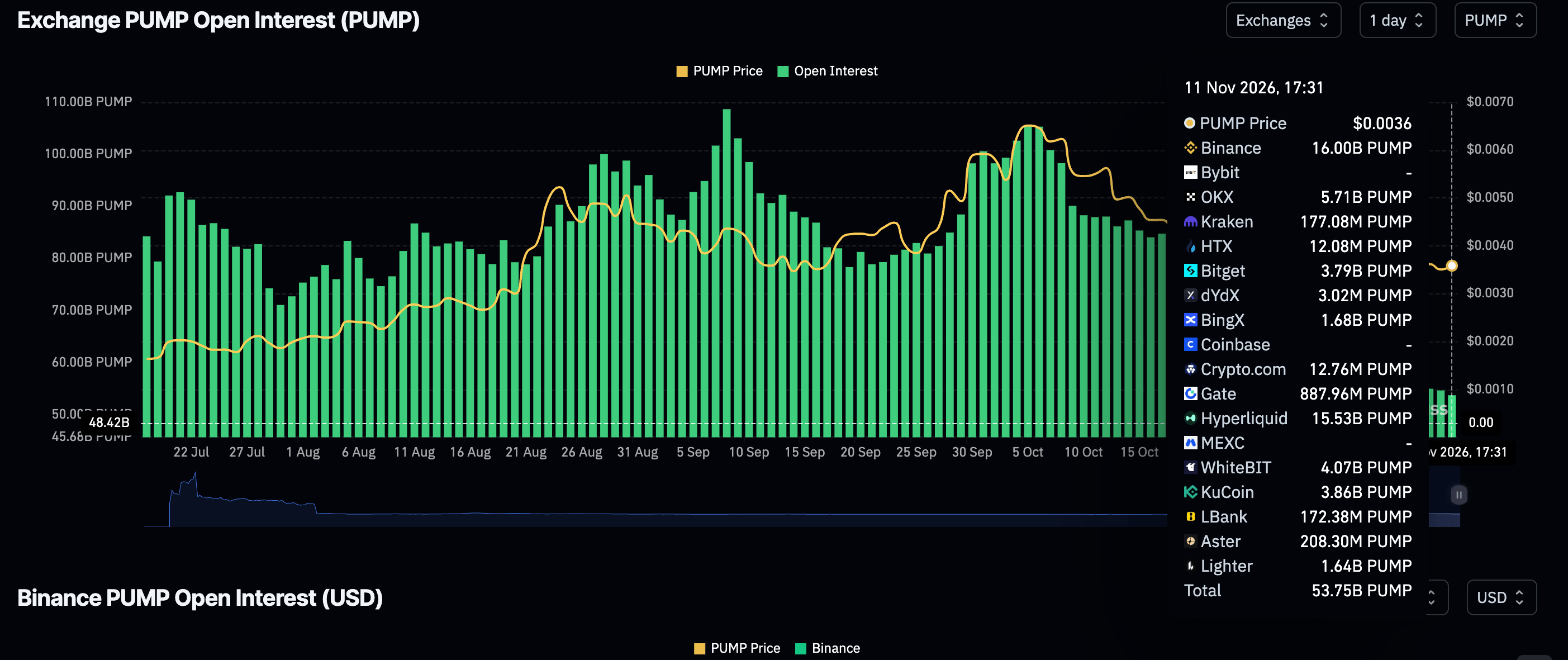
- 54M PUMP in perpetual futures Open Interest, against 88M a month earlier, highlights subdued retail demand for Pump.fun.
- Despite its advance, PUMP remains broadly range-bound, with short-term support at the 200-day EMA and resistance at the 100-day EMA.
$0.0036 is where Pump.fun (PUMP) trades on Wednesday. Momentum is strengthening for the meme coin launchpad's native token, which has gained over 2% on the day following a test of lows near $0.0035.

Bearish signals still dominate the broader technical outlook. Key indicators, including the Moving Average Convergence Divergence (MACD), remain in negative territory. To loosen sellers' grip, the price needs a sustained advance, particularly through psychological barriers at $0.0040 and $0.0050.
54 Million PUMP: Derivatives Demand Remains Weak
Perpetual futures Open Interest (OI) has eased to 54 million PUMP on Wednesday from 55 million a day earlier, leaving the Pump.fun derivatives market firmly bearish. Measuring the notional value of futures contracts still open and unsettled, OI averaged 88 million on 11 October. The decline undermines risk appetite.
With traders staying on the sidelines, any further deterioration in demand would leave the downside as the path of least resistance. PUMP would then be likely to extend its sell-off towards $0.0030.
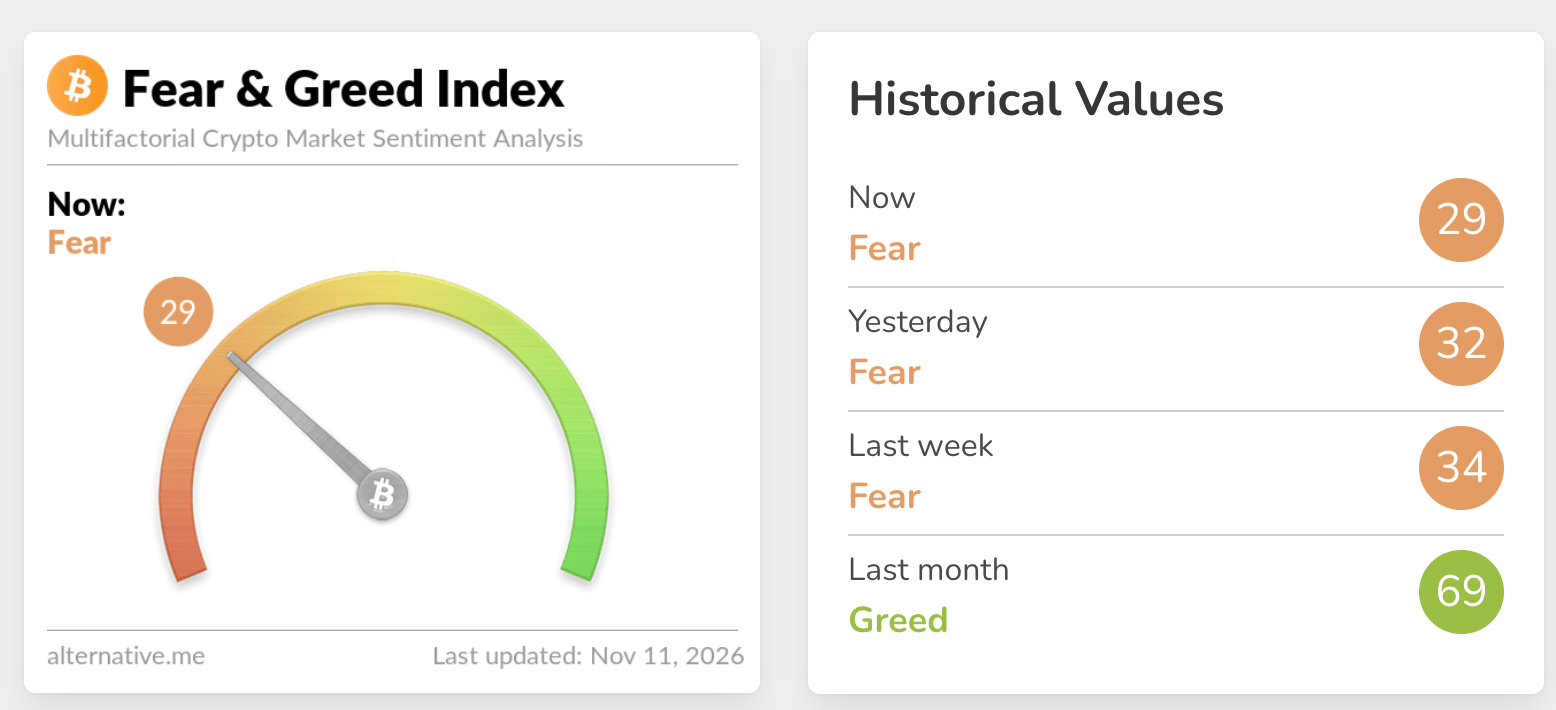
Demand is also retreating across the wider crypto market, not just Pump.fun. On Wednesday, the Fear & Greed Index stands at 29, within Fear territory, after edging down from 32 a day earlier.
Against the previous month's average of 65, the reading indicates that investors are currently risk-averse. This is particularly apparent following the Binance hack and ahead of the Federal Reserve (Fed) monetary policy meeting in December, at which a rate hike is widely anticipated.
200-Day EMA Holds: PUMP Recovery in Technical Focus
At $0.0036, Pump.fun remains below both the 50-day and 100-day Exponential Moving Averages (EMAs), as well as the active SuperTrend line. Together, these keep the short-term outlook bearish. Only a narrow gap separates the price from the 200-day EMA at $0.0034. A broader base may be taking shape, but sellers retain control below a clearly defined descending resistance trendline.
At around 38, the Relative Strength Index (RSI) signals muted demand rather than outright oversold conditions. Meanwhile, the Moving Average Convergence Divergence (MACD) sits near the zero line, suggesting limited momentum within a market structure constrained by overhead resistance.
The former trendline break area near $0.0040 provides the first upside resistance. Should buyers attempt a rebound, the 50-day EMA at $0.0043 presents a second ceiling. Beyond it lies the SuperTrend barrier at $0.0047, the next major obstacle before attention turns to the broader descending trendline zone towards $0.0071.
For the downside, initial significant support sits at the 200-day EMA of $0.0034. Closing below it on a daily basis would leave the pair vulnerable to further losses, prolonging the current bearish phase.
(The technical analysis of this story was written with the help of an AI tool. Know more.)
FAQs on Bitcoin, Altcoins and Stablecoins
Ranked as the largest cryptocurrency by market capitalisation, Bitcoin is a virtual currency created to function as money. No single person, group or entity can control this payment method, removing the need for third parties to participate in financial transactions.
Any cryptocurrency other than Bitcoin is classed as an altcoin. Some, however, also exclude Ethereum, since forks originate from these two cryptocurrencies. Under that interpretation, Litecoin is the first altcoin: it was forked from the Bitcoin protocol and is therefore an “improved” version of it.
Designed to maintain a stable price, stablecoins are cryptocurrencies backed by a reserve of the asset they represent. Each stablecoin is pegged to a commodity or financial instrument, such as the US Dollar (USD), while an algorithm or demand regulates its supply. Their primary purpose is to give investors a way into and out of cryptocurrency trading and investment. Since cryptocurrencies are generally volatile, stablecoins also offer investors a means of storing value.
By comparing Bitcoin's market capitalisation with the combined market capitalisation of all cryptocurrencies, Bitcoin dominance gives a clear indication of investor interest in Bitcoin. BTC dominance is typically high before and during a bull run, as investors favour a relatively stable cryptocurrency with a high market capitalisation, such as Bitcoin. When BTC dominance falls, it usually signals that investors are shifting capital and/or profits into altcoins in pursuit of higher returns. This generally sparks a surge in altcoin rallies.
POPULAR ARTICLES
1New Zealand Dollar slides as Fed hawks reassert control2PUMP Advances Despite Muted Retail Demand: Pump.fun Price Forecast3Above $52: Silver gains despite rising US yields and Fed rate-hike bets4Below 1.33: British Pound slumps after hot US CPI and hawkish Fed rhetoric5March lows in focus as Australian Dollar retreats on diverging Fed and RBA outlooks6159.00 cleared: USD/JPY climbs as Japanese Yen slumps to ten-week low7US Dollar: Fundamental support counters deficit concerns – Rabobank8Two-week low: euro slides on expectations of aggressive Fed rate hikes9October UK inflation set to rise, says Deutsche Bank


Get Started!
Sign up and access the Global Markets in less than 3 minutes

Connect With Us












The information provided on this website is of a general nature only and does not constitute personal financial advice. Before acting on any information on this website, you should consider the suitability of the information in relation to your objectives, financial situation and needs. Investing in CFDs and FX Margin Contracts carries significant risks and is not suitable for all investors. You may lose more than your initial deposit. You do not own, or have, any interest in the underlying asset. We recommend that you seek independent advice and ensure you fully understand the risks involved before trading. It is important that you read and consider the disclosure document before you acquire any product listed on the website. The information and advertisements offered on this website are not intended for use by any person in any country or jurisdiction where such use would be contrary to local laws and regulations. The Products and Services offered on this website are not intended for residents of the United States, Malaysia and Thailand.
TMGM is authorized and regulated in various jurisdictions.
Trademax Australia Limited, trading as TMGM, is regulated by the Australian Securities and Investments Commission (ASIC), AFSL no. 436416 and is located at Level 28, One International Tower, 100 Barangaroo Avenue, 2000 Sydney, NSW Australia.
Email: support@tmgm.com.au
Trademax Global Limited, trading as TMGM, is authorized and regulated by the Vanuatu Financial Services Commission (VFSC), registration number 40356 and registered at 1276, Kumul Highway, Port Vila, Vanuatu, Republic of Vanuatu.
Email: support@tmgm.com
Trademax Global Markets (SE) Limited, trading as TMGM, is authorized and regulated by the Financial Services Authority (FSA) of Seychelles, with license number SD224. The company is registered at Office No 13, Providence Estate ABIS Centre, Mahe, Seychelles.
Email: support@tmgm.com
Trademax Global Markets (International) Pty Ltd, trading as TMGM, is authorized and regulated by the Financial Services Commission, Mauritius (FSC) with license no. GB22201012, and registered at 33, Edith Cavell Street C/o IQ EQ Fund Services (Mauritius) Ltd Port Louis, 11324 Mauritius.
Email: support@tmgm.com
Copyright © TMGM. All rights reserved