

Trading
Explore a wide range of markets with competitive pricing, deep liquidity, and advanced trading tools.
Learn More 
Platform
Trade seamlessly with TMGM's powerful platform, built for speed, precision, and a superior trading experience.
Learn More Trading Platform
Academy
Learn the fundamentals of trading with beginner-friendly resources, including guides, webinars, and market insights.
Learn More News & Analysis
Get real-time market updates and expert analysis to stay ahead of trading opportunities
Learn More News & Analysis
About
Learn what sets TMGM apart — our global presence, regulatory strength, and commitment to innovation in trading.
Learn More Why Choose TMGM
Sponsorship
160.00 under bullish pressure: USD/JPY Price Forecast as intervention risks mount
- Further Fed rate-hike expectations underpin the US Dollar, but fears of Japanese intervention constrain the USD/JPY advance.
- Above the 100-day and 200-day SMAs, USD/JPY maintains its breakout from the recent trading range.
- Near 64, the RSI signals solid upward momentum alongside a positive MACD.
160.00 remains the focus for USD/JPY on Friday. The pair is little changed near that level, with the threat of Japanese intervention containing the upside despite US Dollar (USD) strength. Its advance this week stands at 0.91%, putting it on course for a third consecutive weekly rise. Increasing expectations of further Federal Reserve (Fed) rate hikes continue to keep the US-Japan yield differential favourable to the Dollar.

Preserving an “orderly foreign exchange market,” would remain a government priority, Japanese Prime Minister Sanae Takaichi said on Friday. She added that Japan continues to maintain close contact with US financial authorities.
Yen upside limited as Japan’s rates converge
Expected Bank of Japan tightening is unlikely to offer much near-term support to the currency, according to Commerzbank analysts. They write: “While we also expect the Bank of Japan to implement two further rate rises – in December and in spring next year – this no longer favours the Japanese yen. Rather, it signals a convergence between the central banks, which will likely have little impact on the currency,”
With this in mind, Commerzbank says “we see little potential for the Japanese yen in the near future,” and observes that “in recent days, the yen has already weakened slightly due to rising market expectations regarding the Fed, and is currently trading just below USD-JPY 160.” Its outlook for the coming quarters now allows for only modest gains: “by the middle of next year, we now expect only a slight appreciation towards 155.”
USD/JPY technical outlook
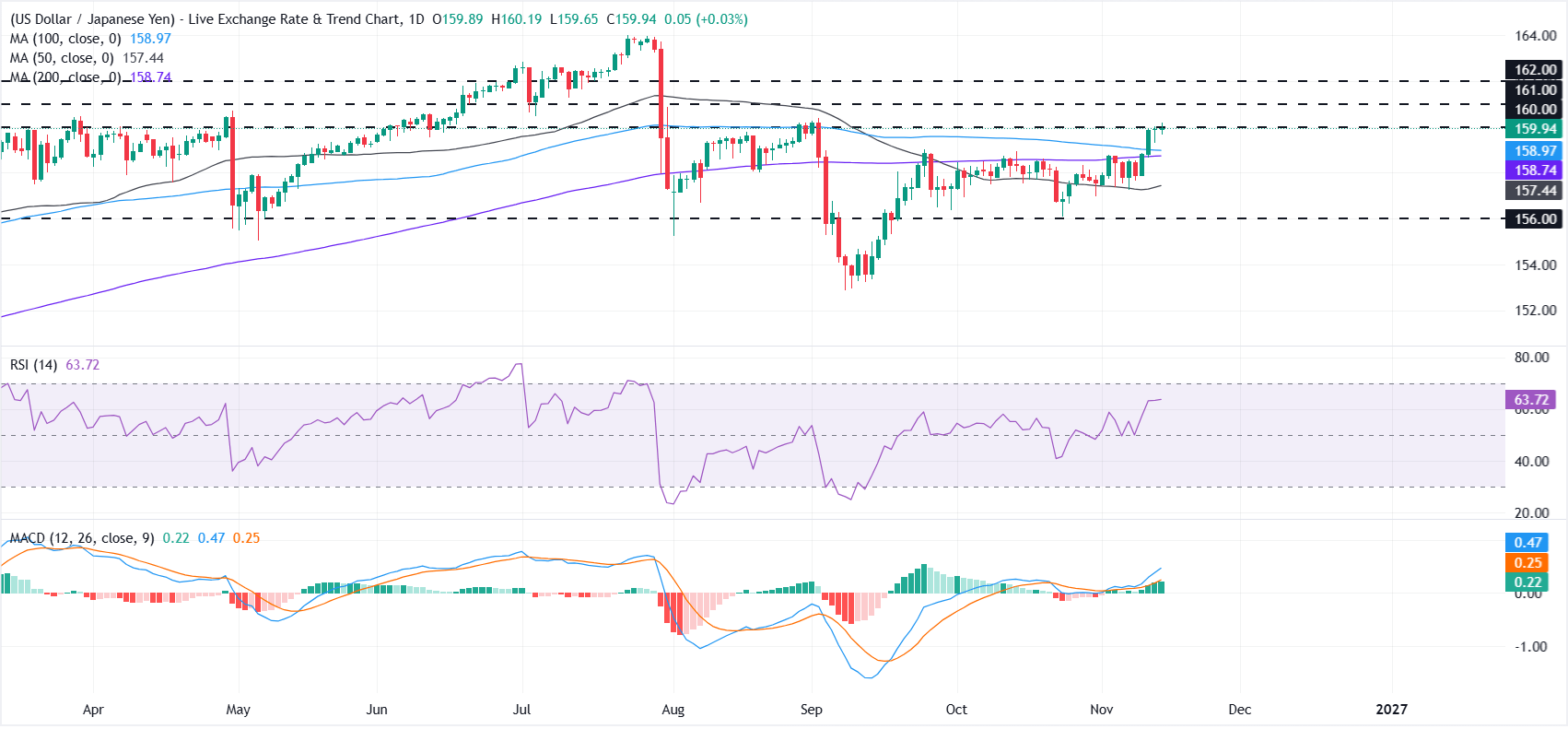
After a strong recovery from September’s 152.89 low, USD/JPY consolidated within a tight range. A fresh advance has now carried it beyond that range and above the 100-day and 200-day Simple Moving Averages (SMAs), at 158.97 and 158.74 respectively.
At 160.00, a horizontal barrier just above the current price provides immediate resistance. The Relative Strength Index (RSI) is strengthening around 64, while the Moving Average Convergence Divergence (MACD) remains positive. Both indicators support the upward momentum and reinforce, rather than contradict, the constructive price structure.
A sustained move through the first resistance at 160.00 would bring 161.00 and 162.00 into view, with selling pressure likely to return at those levels. Below the market, initial buying interest is expected around the current area, supported by the 100-day SMA at 158.97 and the 200-day SMA at 158.74. Further support lies at the 50-day SMA near 157.44, followed by the horizontal base at 156.00.
(The technical analysis of this story was written with the help of an AI tool. Know more.)
Japanese Yen Performance Today
Against the Swiss Franc, the Japanese Yen recorded its strongest performance today. The table below sets out the Japanese Yen’s (JPY) percentage moves against the major currencies listed.
| USD | EUR | GBP | JPY | CAD | AUD | NZD | CHF | |
|---|---|---|---|---|---|---|---|---|
| USD | 0.03% | 0.04% | 0.03% | 0.02% | 0.15% | 0.19% | 0.32% | |
| EUR | -0.03% | 0.01% | 0.02% | 0.00% | 0.12% | 0.17% | 0.29% | |
| GBP | -0.04% | -0.01% | 0.00% | -0.01% | 0.10% | 0.15% | 0.28% | |
| JPY | -0.03% | -0.02% | 0.00% | -0.01% | 0.11% | 0.14% | 0.28% | |
| CAD | -0.02% | 0.00% | 0.00% | 0.00% | 0.12% | 0.16% | 0.29% | |
| AUD | -0.15% | -0.12% | -0.10% | -0.11% | -0.12% | 0.04% | 0.17% | |
| NZD | -0.19% | -0.17% | -0.15% | -0.14% | -0.16% | -0.04% | 0.14% | |
| CHF | -0.32% | -0.29% | -0.28% | -0.28% | -0.29% | -0.17% | -0.14% |
Percentage movements between major currencies are displayed in the heat map. Select the base currency in the left-hand column and the quote currency in the top row. To read JPY (base)/USD (quote), for example, locate the Japanese Yen on the left and follow its row across to the US Dollar column. The intersecting cell gives the percentage change for that pair.
POPULAR ARTICLES
1December rate hike expected from Bank of Japan: Why is the Japanese Yen still weakening?20.5527 in focus: NZD/USD price forecast as bears build momentum to test 19-month lows3200-day average reclaimed as Brent oil rebounds – BBH4160.00 under bullish pressure: USD/JPY Price Forecast as intervention risks mount5$20 Million in 24-Hour Liquidations: Ripple Price Forecast Puts XRP’s $1.00 Support at Risk6Below $87: WTI Oil pares gains on bets of a steeper Fed tightening cycle71.3140 Area: GBP/USD Price Forecast Points to Likely Retest of Four-Month Low8CEE FX: Downward Pressure Continues – ING9US Dollar Rally Continues as PPI Takes Centre Stage – BBH


Get Started!
Sign up and access the Global Markets in less than 3 minutes

Connect With Us












The information provided on this website is of a general nature only and does not constitute personal financial advice. Before acting on any information on this website, you should consider the suitability of the information in relation to your objectives, financial situation and needs. Investing in CFDs and FX Margin Contracts carries significant risks and is not suitable for all investors. You may lose more than your initial deposit. You do not own, or have, any interest in the underlying asset. We recommend that you seek independent advice and ensure you fully understand the risks involved before trading. It is important that you read and consider the disclosure document before you acquire any product listed on the website. The information and advertisements offered on this website are not intended for use by any person in any country or jurisdiction where such use would be contrary to local laws and regulations. The Products and Services offered on this website are not intended for residents of the United States, Malaysia and Thailand.
TMGM is authorized and regulated in various jurisdictions.
Trademax Australia Limited, trading as TMGM, is regulated by the Australian Securities and Investments Commission (ASIC), AFSL no. 436416 and is located at Level 28, One International Tower, 100 Barangaroo Avenue, 2000 Sydney, NSW Australia.
Email: support@tmgm.com.au
Trademax Global Limited, trading as TMGM, is authorized and regulated by the Vanuatu Financial Services Commission (VFSC), registration number 40356 and registered at 1276, Kumul Highway, Port Vila, Vanuatu, Republic of Vanuatu.
Email: support@tmgm.com
Trademax Global Markets (SE) Limited, trading as TMGM, is authorized and regulated by the Financial Services Authority (FSA) of Seychelles, with license number SD224. The company is registered at Office No 13, Providence Estate ABIS Centre, Mahe, Seychelles.
Email: support@tmgm.com
Trademax Global Markets (International) Pty Ltd, trading as TMGM, is authorized and regulated by the Financial Services Commission, Mauritius (FSC) with license no. GB22201012, and registered at 33, Edith Cavell Street C/o IQ EQ Fund Services (Mauritius) Ltd Port Louis, 11324 Mauritius.
Email: support@tmgm.com
Copyright © TMGM. All rights reserved