

Trading
Explore a wide range of markets with competitive pricing, deep liquidity, and advanced trading tools.
Learn More 
Platform
Trade seamlessly with TMGM's powerful platform, built for speed, precision, and a superior trading experience.
Learn More Trading Platform
Academy
Learn the fundamentals of trading with beginner-friendly resources, including guides, webinars, and market insights.
Learn More News & Analysis
Get real-time market updates and expert analysis to stay ahead of trading opportunities
Learn More News & Analysis
About
Learn what sets TMGM apart — our global presence, regulatory strength, and commitment to innovation in trading.
Learn More Why Choose TMGM
Sponsorship
Bitcoin and Gold Outlook: Democrats gain control of Congress as BTC breaks above $80K and XAU regains $4,000
- Sentiment across the cryptocurrency market improves as Bitcoin climbs above $80,000.
- Bullish sentiment strengthens in Gold as buyers reposition above $4,000, lending momentum to the metal.
- With a narrow lead over Republicans in the US midterm elections, Democrats are poised to control the House and Senate in January.
A bullish revival is gathering pace in Bitcoin (BTC) and Gold (XAU/USD) on Wednesday. Having recovered the steep losses triggered by the Binance hack, which affected $6.3 billion, BTC is signalling a bullish reversal above $80,000. For Gold, a rebound above $4,000 could bolster bullish sentiment following the United States (US) midterm elections.

Are Democrats on course to control Congress after edging Republicans?
Control of the House and Senate is set to pass to the Democratic Party in January following its stronger showing against Republicans in Tuesday’s US midterm elections. NBC News reported that Democrats flipped seven Senate seats: Iowa, Kansas, Maine, North Carolina, Ohio, South Carolina and Texas.
A projected 258 seats in the House of Representatives would put Democrats above the 218 required for a majority, the report adds. Their winning run also extended to governorships, with Texas, Nevada, Ohio, Georgia and Iowa flipping to the party. Among the drivers of these sweeping gains were worries over the economy against a backdrop of high Oil and energy prices.
For Crypto, further obstacles could await the CLARITY Act if it is introduced again, after its earlier failure to clear the Senate.
In emailed commentary, Joel Kruger, Global Market Strategist at LMAX Group, said: “Much of the election outcome was already priced in. Even sizable Democratic majorities are unlikely to yield the votes needed to override a presidential veto, so while political noise may persist, the scope for legislation that materially changes the economic outlook looks limited,”
Prices have nevertheless moved higher in the immediate aftermath: Bitcoin has climbed above $80,000, while Ethereum (ETH) has advanced beyond $2,400. Investors appear willing to return as Gold stays above $4,000. Whether buyers consolidate their hold or the current recovery fails will depend crucially on the coming sessions.
Kruger also said: “With election uncertainty fading, we see room for investors to buy the dip in risk assets and trim dollar longs, while Treasury yields drift lower as markets pare expectations for additional Fed hikes beyond December,”
Technical analysis: Can Bitcoin bulls consolidate their hold as prices rally?
A favourable near-term bullish outlook remains intact for Bitcoin at $80,640, with the price above the 200-day and 100-day Exponential Moving Averages (EMAs) of $76,533 and $77,849. Trading marginally above the 50-day EMA of $80,153 also points to demand gathering around the latest breakout zone.
Although the Relative Strength Index (RSI) is close to neutral at 51, it retains a slight upward bias. Meanwhile, a modestly negative Moving Average Convergence Divergence (MACD) reading below zero suggests selling momentum is easing rather than intensifying.
The first downside support is the 50-day EMA near $80,153. Below it sit the 100-day EMA at $77,849 and a stronger structural base at the 200-day EMA around $76,533. A move higher would next encounter resistance at the $82,920 SuperTrend line; failure to establish a lasting break above that level could bring fresh selling pressure.
Gold technical analysis: Can XAU sustain its advance above $4,000?
The prospect of a bullish turnaround is improving as Gold advances to around $4,045. Yet its near-term outlook remains bearish despite the recent gains, with prices still beneath a closely grouped set of moving-average and trendline resistance levels. Above Spot Gold are the 50-day EMA at $4,160, the 100-day EMA at $4,240 and the 200-day EMA at $4,264. The SuperTrend indicator at $4,163 further points to selling interest overhead.
There is no uniform momentum signal: the RSI is near neutral at 47, while the MACD is recovering but remains negative. Together, these readings point to waning downside pressure rather than a decisive bullish reversal.
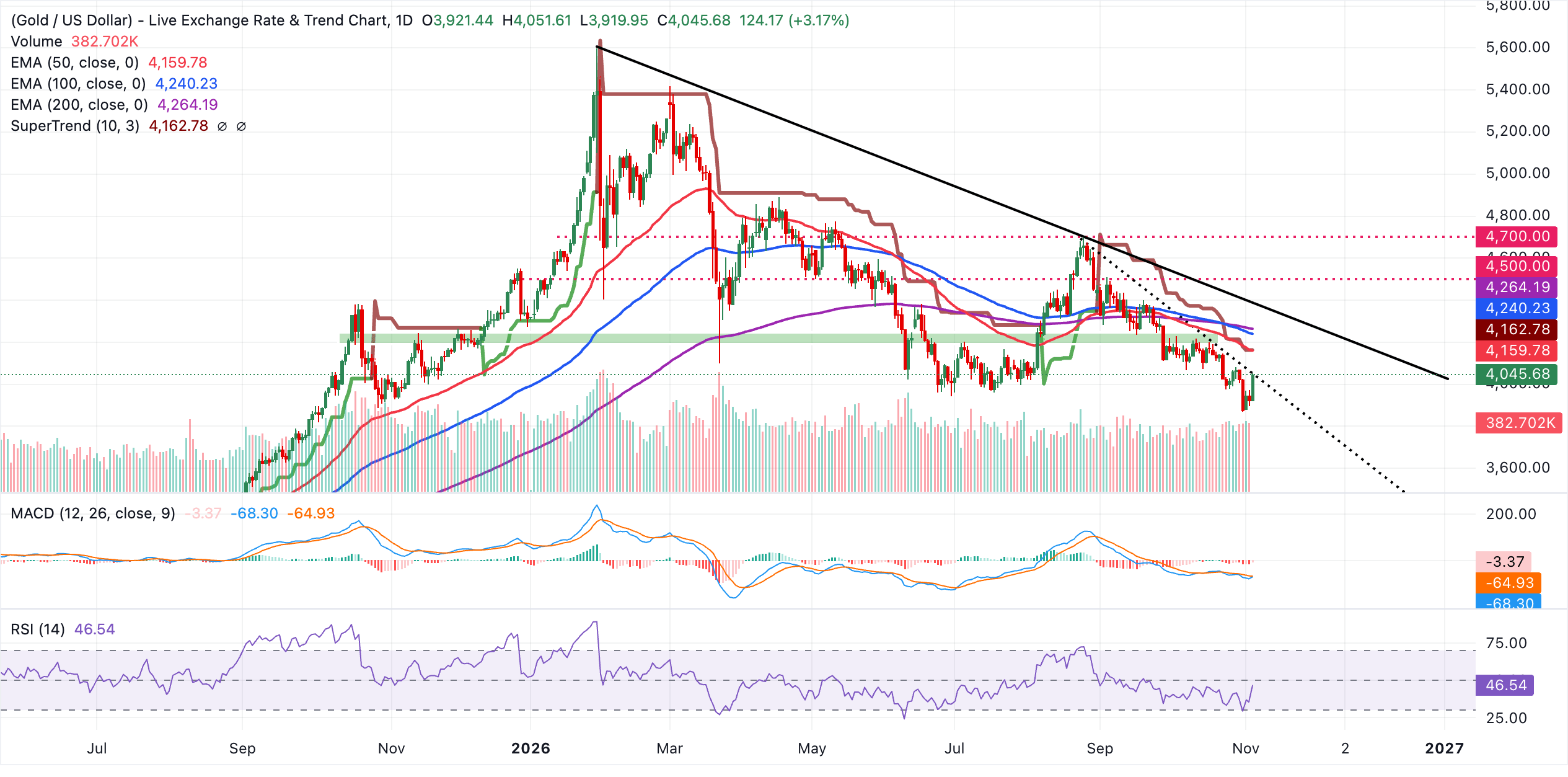
The 50-day EMA at $4,160 and SuperTrend line at $4,163 form the first resistance cluster, followed by the 100-day EMA at $4,240. Further up, a broader ceiling comprises the 200-day EMA at $4,264 and the descending trendline break level near $4,299. Bulls would need to regain those levels to alter the medium-term outlook. On a deeper pullback, initial support is at the secondary trendline break around $3,947, where former resistance could provide a structural base.
(The technical analysis of this story was written with the help of an AI tool. Know more.)
FAQs on Bitcoin, altcoins and stablecoins
Ranked as the largest cryptocurrency by market capitalisation, Bitcoin is a virtual currency created to function as money. No single individual, group or entity can control this payment method, removing the requirement for third-party involvement in financial transactions.
The term altcoin covers every cryptocurrency other than Bitcoin. Some also exclude Ethereum, however, on the grounds that these two cryptocurrencies are the source of forks. Under that interpretation, Litecoin is the first altcoin: a fork of the Bitcoin protocol and thus an “improved” version of it.
To maintain a steady price, stablecoins are backed by reserves of the assets they represent. Each stablecoin’s value is linked to a commodity or financial instrument, such as the US Dollar (USD), and an algorithm or demand governs its supply. Their primary purpose is to offer a route into and out of cryptocurrencies for investors looking to trade and invest in them. Given the volatility generally associated with cryptocurrencies, stablecoins also provide investors with a way to store value.
By comparing Bitcoin’s market capitalisation with the combined market capitalisation of all cryptocurrencies, Bitcoin dominance offers a clear measure of investor interest in Bitcoin. BTC dominance is typically high ahead of and during a bull run, as investors favour a relatively stable cryptocurrency with a large market capitalisation, such as Bitcoin. When BTC dominance declines, it usually signals that investors are shifting capital and/or profits into altcoins in pursuit of better returns, often setting off a surge in altcoin rallies.
POPULAR ARTICLES
1WTI tumbles 9% as hopes of an end to Iran war grow following US election results2USD weakness lifts New Zealand Dollar despite NZ jobless rate reaching an 11-year high3Bitcoin and Gold Outlook: Democrats gain control of Congress as BTC breaks above $80K and XAU regains $4,0004Australian Dollar rebounds as dovish RBA signals take a back seat to US election fallout5Euro area: Are core inflation risks increasing? – Commerzbank6Can the British Pound stay near a seven-week high as US elections weigh on USD and BoE looms?7US Dollar: Could payrolls trigger a relief sell-off? – TD Securities8Mexican Peso: What Risks Lie Ahead With Banxico on Hold? – Rabobank9EUR/USD Price Forecast: What does an emerging double bottom signal as buyers retake control?


Get Started!
Sign up and access the Global Markets in less than 3 minutes

Connect With Us












The information provided on this website is of a general nature only and does not constitute personal financial advice. Before acting on any information on this website, you should consider the suitability of the information in relation to your objectives, financial situation and needs. Investing in CFDs and FX Margin Contracts carries significant risks and is not suitable for all investors. You may lose more than your initial deposit. You do not own, or have, any interest in the underlying asset. We recommend that you seek independent advice and ensure you fully understand the risks involved before trading. It is important that you read and consider the disclosure document before you acquire any product listed on the website. The information and advertisements offered on this website are not intended for use by any person in any country or jurisdiction where such use would be contrary to local laws and regulations. The Products and Services offered on this website are not intended for residents of the United States, Malaysia and Thailand.
TMGM is authorized and regulated in various jurisdictions.
Trademax Australia Limited, trading as TMGM, is regulated by the Australian Securities and Investments Commission (ASIC), AFSL no. 436416 and is located at Level 28, One International Tower, 100 Barangaroo Avenue, 2000 Sydney, NSW Australia.
Email: support@tmgm.com.au
Trademax Global Limited, trading as TMGM, is authorized and regulated by the Vanuatu Financial Services Commission (VFSC), registration number 40356 and registered at 1276, Kumul Highway, Port Vila, Vanuatu, Republic of Vanuatu.
Email: support@tmgm.com
Trademax Global Markets (SE) Limited, trading as TMGM, is authorized and regulated by the Financial Services Authority (FSA) of Seychelles, with license number SD224. The company is registered at Office No 13, Providence Estate ABIS Centre, Mahe, Seychelles.
Email: support@tmgm.com
Trademax Global Markets (International) Pty Ltd, trading as TMGM, is authorized and regulated by the Financial Services Commission, Mauritius (FSC) with license no. GB22201012, and registered at 33, Edith Cavell Street C/o IQ EQ Fund Services (Mauritius) Ltd Port Louis, 11324 Mauritius.
Email: support@tmgm.com
Copyright © TMGM. All rights reserved