

British Pound Sterling did not earn its three-month high
- GBP/USD clears 1.3550 to a three-month high and gives it straight back.
- Claimant count change seen at 11.2K on Tuesday, against 6.7K prior.
- July headline CPI seen at 2.9% with core easing to 2.5%.
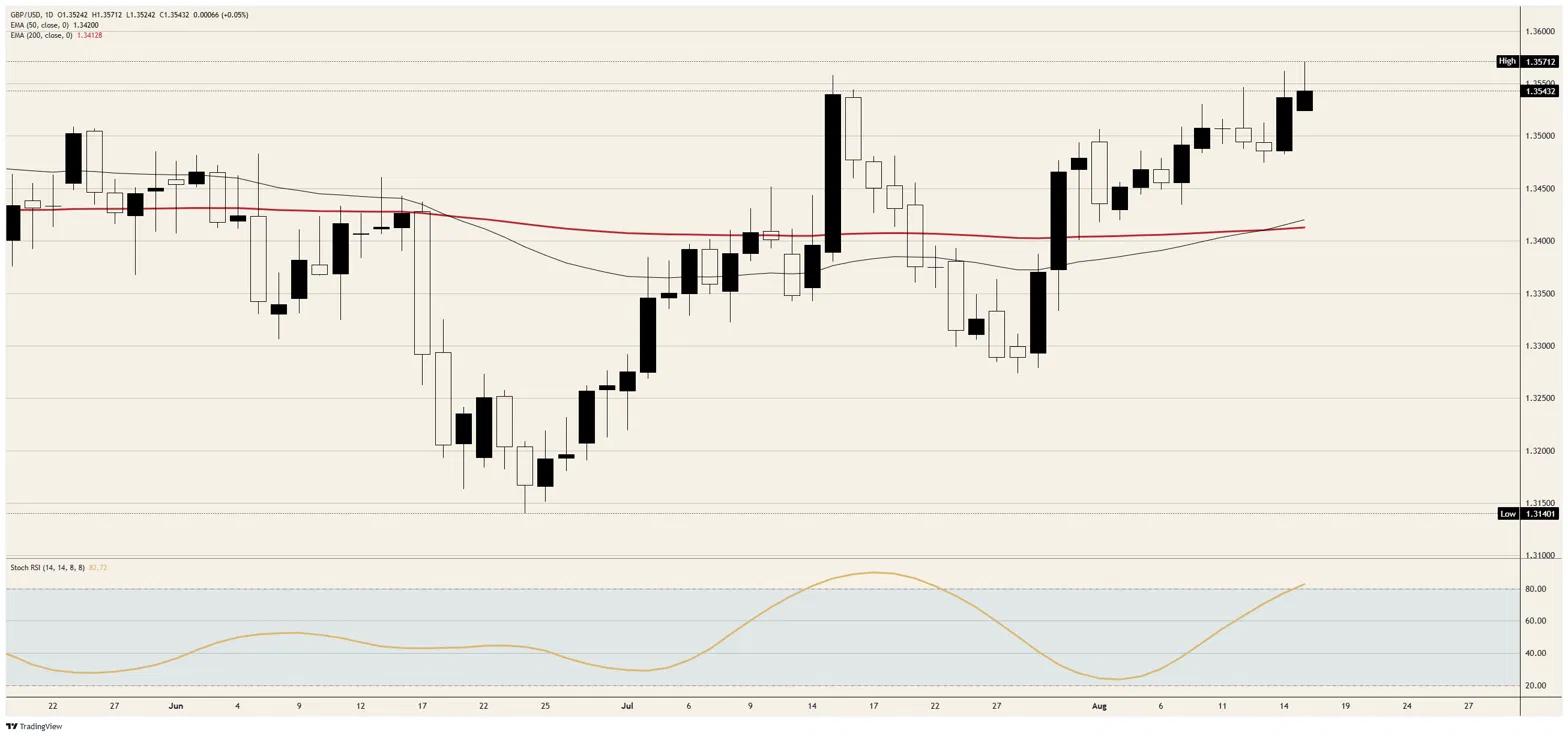
GBP/USD cleared 1.3550 on Monday for the first time in three months, printed the highest level of the window just above it and handed the entire advance back within hours for a net gain under 10 pips. Sterling did none of the work behind that number. The Dollar Index broke beneath its 200-day Exponential Moving Average (EMA) to its weakest since June, and the majors rose against it in a block.

Monday belonged to the Dollar
The breadth gives the move away. The Euro reached a two-month high, Gold was bid and the Pound reached three-month peaks on the same afternoon, which is the signature of one currency being sold rather than four being bought. Futures had already cut September Federal Reserve hike odds from a coin flip on August 10 to roughly a third across the previous week, and Monday added the rest.
What Monday added was a war deadline. The 60-day framework meant to end the fight over the Strait of Hormuz expired with nothing agreed, Crude Oil rose roughly 3% and the 30-year Treasury yield topped 5.31%, its highest since June 2007. Sterling contributed no domestic input to any of it, having had no first-tier release of its own since July 30.
Tuesday is where the Pound starts paying
The labour market file lands at 06:00 GMT and it does not agree with itself. The unemployment rate is seen easing to 4.8% from 4.9% on the three months to June, while the claimant count change for July is seen at 11.2K against 6.7K, a near doubling, on a claimant rate that has been running 4.4%. Prior employment change was 147K.
Pay is the number that carries into Wednesday. Regular earnings are seen unchanged at 3.4% and total pay easing to 4.1% from 4.3%, so a headline inflation rate heading to 2.9% leaves real wage growth of roughly half a point. That is a household squeeze arriving through energy rather than through wages, which is the shape of this entire cycle.
Wednesday decides the September vote
Consumer Price Index (CPI) figures at 06:00 GMT are the week's decisive release. Headline is seen at 0.3% MoM and 2.9% YoY from 2.6%, while core eases to 2.5% from 2.6% and producer output prices lift 0.3% MoM from flat. Headline rising while core falls is imported inflation, and imported inflation is the one variety a central bank cannot answer with rates without taxing an economy that is already slowing.
The July hold went 6-3, following 7-2 in June and 8-1 in April, so the hawkish minority has grown at three consecutive meetings. Markets price roughly a quarter chance of a move on September 17. A 2.9% headline hands the dissenters a number to point at, and a 2.5% core hands the majority its answer, which is why Sterling's reaction on the day is unlikely to survive the week.
Friday closes the argument
Retail sales at 06:00 GMT are seen contracting 0.3% MoM from a 1% gain, with the ex-fuel measure at -0.4% from 1.1% and the annual rate halving to 2.3% from 4.2%. A consumer confidence survey lands the evening before at -18 from -17, so the household file gets two readings inside twelve hours and both consensus figures point the same way.
Preliminary August Purchasing Managers Index (PMI) readings follow at 08:30 GMT, composite seen at 51.5 from 52.2, manufacturing 51.5 from 51.9 and services 51.8 from 52.1. Every UK consensus this week points lower except the inflation line, which is the arrangement that makes a currency difficult to own and the reason a rate-differential bid is unlikely to appear from this side of the pair.
The Dollar leg still runs the pair
The Federal Open Market Committee (FOMC) publishes minutes from the July 29 meeting on Wednesday at 18:00 GMT, and they are the only scheduled event this week capable of rebuilding the rate premium the past fortnight stripped out of the Dollar. The question inside them is how close the rest of that committee sat to the three who dissented for a quarter point, and the account predates the soft American inflation prints entirely.
American preliminary PMI readings arrive Friday at 13:45 GMT, manufacturing seen at 53.8 and services at 54, both marginally beneath July. Beyond the week sits the Jackson Hole symposium on August 27-29 with the chair's keynote on the Friday, which is the more plausible reversal risk for anyone short the Dollar and the reason this pair's upside is a borrowed position rather than an owned one.
GBP/USD technical levels
Resistance: 1.3550 is the line the pair failed at on the session it took it, with 1.3600 above and 1.3650 beyond that on any Dollar-led extension.
Support: 1.3500 is the first shelf, then 1.3450, then the moving-average band near 1.3400 where a rising 50-day EMA has just crossed back above the 200-day.
Bias: Bearish. A daily Stochastic Relative Strength Index (Stoch RSI) above 80, a three-month high rejected on the day it printed and a domestic calendar whose consensus points down everywhere but the inflation line make this a pair to sell into strength. Objectives 1.3500 then 1.3450, invalidation on a daily close above 1.3600.
GBP/USD daily chart
Pound Sterling FAQs
The Pound Sterling (GBP) is the oldest currency in the world (886 AD) and the official currency of the United Kingdom. It is the fourth most traded unit for foreign exchange (FX) in the world, accounting for 12% of all transactions, averaging $630 billion a day, according to 2022 data. Its key trading pairs are GBP/USD, also known as ‘Cable’, which accounts for 11% of FX, GBP/JPY, or the ‘Dragon’ as it is known by traders (3%), and EUR/GBP (2%). The Pound Sterling is issued by the Bank of England (BoE).
The single most important factor influencing the value of the Pound Sterling is monetary policy decided by the Bank of England. The BoE bases its decisions on whether it has achieved its primary goal of “price stability” – a steady inflation rate of around 2%. Its primary tool for achieving this is the adjustment of interest rates. When inflation is too high, the BoE will try to rein it in by raising interest rates, making it more expensive for people and businesses to access credit. This is generally positive for GBP, as higher interest rates make the UK a more attractive place for global investors to park their money. When inflation falls too low it is a sign economic growth is slowing. In this scenario, the BoE will consider lowering interest rates to cheapen credit so businesses will borrow more to invest in growth-generating projects.
Data releases gauge the health of the economy and can impact the value of the Pound Sterling. Indicators such as GDP, Manufacturing and Services PMIs, and employment can all influence the direction of the GBP. A strong economy is good for Sterling. Not only does it attract more foreign investment but it may encourage the BoE to put up interest rates, which will directly strengthen GBP. Otherwise, if economic data is weak, the Pound Sterling is likely to fall.
Another significant data release for the Pound Sterling is the Trade Balance. This indicator measures the difference between what a country earns from its exports and what it spends on imports over a given period. If a country produces highly sought-after exports, its currency will benefit purely from the extra demand created from foreign buyers seeking to purchase these goods. Therefore, a positive net Trade Balance strengthens a currency and vice versa for a negative balance.













