

Trading
Explore a wide range of markets with competitive pricing, deep liquidity, and advanced trading tools.
Learn More 
Platform
Trade seamlessly with TMGM's powerful platform, built for speed, precision, and a superior trading experience.
Learn More Trading Platform
Academy
Learn the fundamentals of trading with beginner-friendly resources, including guides, webinars, and market insights.
Learn More News & Analysis
Get real-time market updates and expert analysis to stay ahead of trading opportunities
Learn More News & Analysis
About
Learn what sets TMGM apart — our global presence, regulatory strength, and commitment to innovation in trading.
Learn More Why Choose TMGM
Sponsorship
Nasdaq drops to a one-week low as chip stocks retreat
- Nasdaq leads the decline, hitting its lowest since November 9 as SPX and DJIA post smaller losses.
- Chinese firms face losing access to rented Nvidia chips as Commerce acts to shut a loophole.
- Tuesday's close of US trading will be followed by Nvidia's third-quarter results.
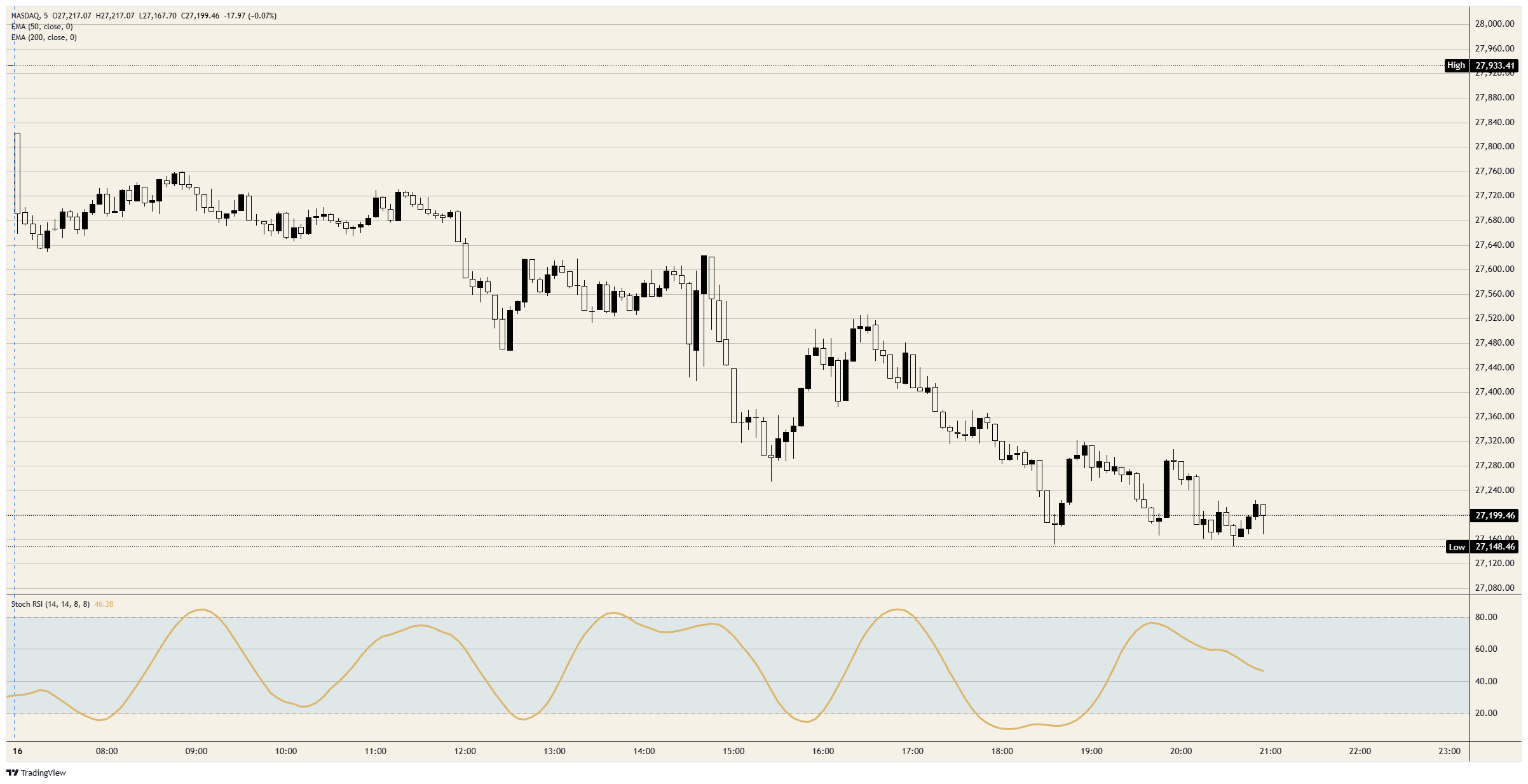
All three US stock indices have slipped to one-week lows, weighed down by a US export rule targeting Nvidia (NVDA) and new developments concerning its leadership. Leading the losses, the Nasdaq 100 opened below Friday's closing level and remained below its opening level throughout trading, sliding towards 27,200, its lowest since November 9. The S&P 500 is trading around 7,425, while the Dow Jones Industrial Average stands near 51,600.

In the first US policy action since Jensen Huang stepped down as chief executive, the Commerce Department acted to shut a loophole allowing Chinese companies to rent Nvidia's computing power outside China. Losses were about 4% for Nvidia, more than 7% for both Micron (MU) and Intel (INTC), and about 5% for Advanced Micro Devices (AMD). With technology stocks carrying a greater weight in the NASDAQ 100 than in the other two indices, its decline was the steepest.
After Treasury Secretary Bessent called on Nvidia to recruit from outside the company, CNBC reported that its board was not considering Huang's return. From around 27,350 at the time of the report, the NASDAQ 100 subsequently dropped to a session low just below 27,150. Selling also spread to the Dow Jones Industrial Average through banking stocks: Goldman Sachs (GS), Morgan Stanley (MS) and JPMorgan Chase (JPM) each shed more than 2%.
Which events are next on the calendar?
Due after the end of US trading on Tuesday, Nvidia's third-quarter results will be its first with Huang no longer serving as chief executive. Wednesday is the scheduled pricing day for Anthropic's initial public offering, at $70-$78 a share, ahead of its Nasdaq exchange trading debut on Thursday. These two events will test appetite for the artificial intelligence (AI) stocks at the centre of Monday's sell-off.
Tuesday brings October retail sales at 13:30 GMT, followed on Wednesday at 19:00 GMT by the minutes of the Fed's October 27-28 meeting. That meeting ended with a 10-2 vote to leave the rate at 3.75%-4.00%. With traders pricing in a quarter-point increase at the December 8-9 meeting, the minutes are chiefly relevant for what they reveal about how many officials had already favoured a hike.
What do the charts indicate?
Since Friday, the NASDAQ 100 has remained below its 200-day Exponential Moving Average (EMA), near 28,150, and has now surrendered about 70% of its recovery from the low near 26,600. The S&P 500, by contrast, continues to hold above its 200-day EMA of around 7,375. After finishing every session from November 9 to November 13 above its 50-day EMA, the Dow Jones Industrial Average has slipped back below that average, near 52,100.
Nasdaq chart: 5-minute timeframe
Nasdaq: Frequently Asked Questions
Based in the US, the Nasdaq operates as a stock exchange, having begun as an electronic system for quoting stock prices. Its original role was limited to supplying quotations for over-the-counter (OTC) stocks; it subsequently developed into an exchange. Its share of the entire US securities market had reached 46% by 1991. In 1998, the Nasdaq became the first US stock exchange to offer online trading. It also compiles several indices, including the Nasdaq 100 and its broadest measure, the Nasdaq Composite, which covers all 2,500-plus stocks listed on the Nasdaq.
Comprising 100 non-financial companies listed on the Nasdaq stock exchange, the Nasdaq 100 is a large-cap index. These constituents represent only a small proportion of the thousands of Nasdaq stocks, yet account for over 90% of its movement. Each company's weight in the index is determined by its market capitalisation. Technology-focused businesses feature prominently, alongside companies from other sectors and those based outside the US. Since 1986, the Nasdaq 100 has delivered an average annual return of 17.23%.
Traders can access the Nasdaq 100 through several instruments. Contracts for Difference (CFD) are available for bets through most retail brokers and spread betting platforms. For investors with a longer horizon, Exchange-Traded Funds (ETFs) offer share-like trading while tracking the index, removing the need to purchase shares in all 100 constituent companies. The Invesco QQQ Trust (QQQ) is one such ETF. Futures contracts on the Nasdaq 100 enable speculation on the index's future direction. Options, meanwhile, confer the right, without imposing an obligation, to buy or sell the Nasdaq 100 at a specified future price, known as the strike price.
The combined performance of its constituent companies, as disclosed in quarterly and annual earnings reports, is the principal driver of the Nasdaq 100, although several other factors also matter. Economic releases from the US and elsewhere shape investor sentiment, with positive sentiment supporting gains. Interest rates determined by the Federal Reserve (Fed) are another influence, since they dictate borrowing costs for the many companies that rely heavily on credit. Inflation can therefore be an important driver, alongside other indicators that inform the Fed's decisions.
POPULAR ARTICLES
1Nasdaq drops to a one-week low as chip stocks retreat2Ethereum Price Forecast: Why does BitMine see a SpaceX IPO-like trend in ETH ahead of Anthropic IPO?3Bitcoin’s recovery hinges on holding $57,800, says Bitfinex4Broadening inflation: Fed's Hammack favours gradual rate hikes5Eurozone: Is the Manufacturing Outlook Still Fragile? – ING6EUR/USD Price Forecast: Can bears breach 1.1000 with RSI near oversold territory?7Forex Today: Market attention turns to US consumer spending and UK jobs8Why are safe-haven demand and intervention fears supporting the Japanese Yen?9How could superintelligence affect jobs, productivity and monetary policy? Fed assesses implications


Get Started!
Sign up and access the Global Markets in less than 3 minutes

Connect With Us












The information provided on this website is of a general nature only and does not constitute personal financial advice. Before acting on any information on this website, you should consider the suitability of the information in relation to your objectives, financial situation and needs. Investing in CFDs and FX Margin Contracts carries significant risks and is not suitable for all investors. You may lose more than your initial deposit. You do not own, or have, any interest in the underlying asset. We recommend that you seek independent advice and ensure you fully understand the risks involved before trading. It is important that you read and consider the disclosure document before you acquire any product listed on the website. The information and advertisements offered on this website are not intended for use by any person in any country or jurisdiction where such use would be contrary to local laws and regulations. The Products and Services offered on this website are not intended for residents of the United States, Malaysia and Thailand.
TMGM is authorized and regulated in various jurisdictions.
Trademax Australia Limited, trading as TMGM, is regulated by the Australian Securities and Investments Commission (ASIC), AFSL no. 436416 and is located at Level 28, One International Tower, 100 Barangaroo Avenue, 2000 Sydney, NSW Australia.
Email: support@tmgm.com.au
Trademax Global Limited, trading as TMGM, is authorized and regulated by the Vanuatu Financial Services Commission (VFSC), registration number 40356 and registered at 1276, Kumul Highway, Port Vila, Vanuatu, Republic of Vanuatu.
Email: support@tmgm.com
Trademax Global Markets (SE) Limited, trading as TMGM, is authorized and regulated by the Financial Services Authority (FSA) of Seychelles, with license number SD224. The company is registered at Office No 13, Providence Estate ABIS Centre, Mahe, Seychelles.
Email: support@tmgm.com
Trademax Global Markets (International) Pty Ltd, trading as TMGM, is authorized and regulated by the Financial Services Commission, Mauritius (FSC) with license no. GB22201012, and registered at 33, Edith Cavell Street C/o IQ EQ Fund Services (Mauritius) Ltd Port Louis, 11324 Mauritius.
Email: support@tmgm.com
Copyright © TMGM. All rights reserved