

Trading
Explore a wide range of markets with competitive pricing, deep liquidity, and advanced trading tools.
Learn More 
Platform
Trade seamlessly with TMGM's powerful platform, built for speed, precision, and a superior trading experience.
Learn More Trading Platform
Academy
Learn the fundamentals of trading with beginner-friendly resources, including guides, webinars, and market insights.
Learn More News & Analysis
Get real-time market updates and expert analysis to stay ahead of trading opportunities
Learn More News & Analysis
About
Learn what sets TMGM apart — our global presence, regulatory strength, and commitment to innovation in trading.
Learn More Why Choose TMGM
Sponsorship
Ripple Price Forecast: XRP remains range-bound as retail and institutional capital flows out
Recovery momentum in XRP is gradually strengthening, with the token trading just above $0.94, although gains remain restricted below $1.00.
Selling pressure is intensifying in XRP derivatives, where Open Interest stands at 1.87B XRP, while spot ETFs record weekly outflows of $11 million.
Gradual improvements in MACD and RSI are supporting XRP’s recovery, though the rebound remains limited.
A modest revival in buying across the broader crypto market is supporting Ripple (XRP), which trades higher at $0.94 on Monday. The token has risen from last week’s lows near $0.86 but remains confined between short-term support at $0.90 and supply at $1.00.

Why is XRP losing ETF capital as leveraged traders pull back?
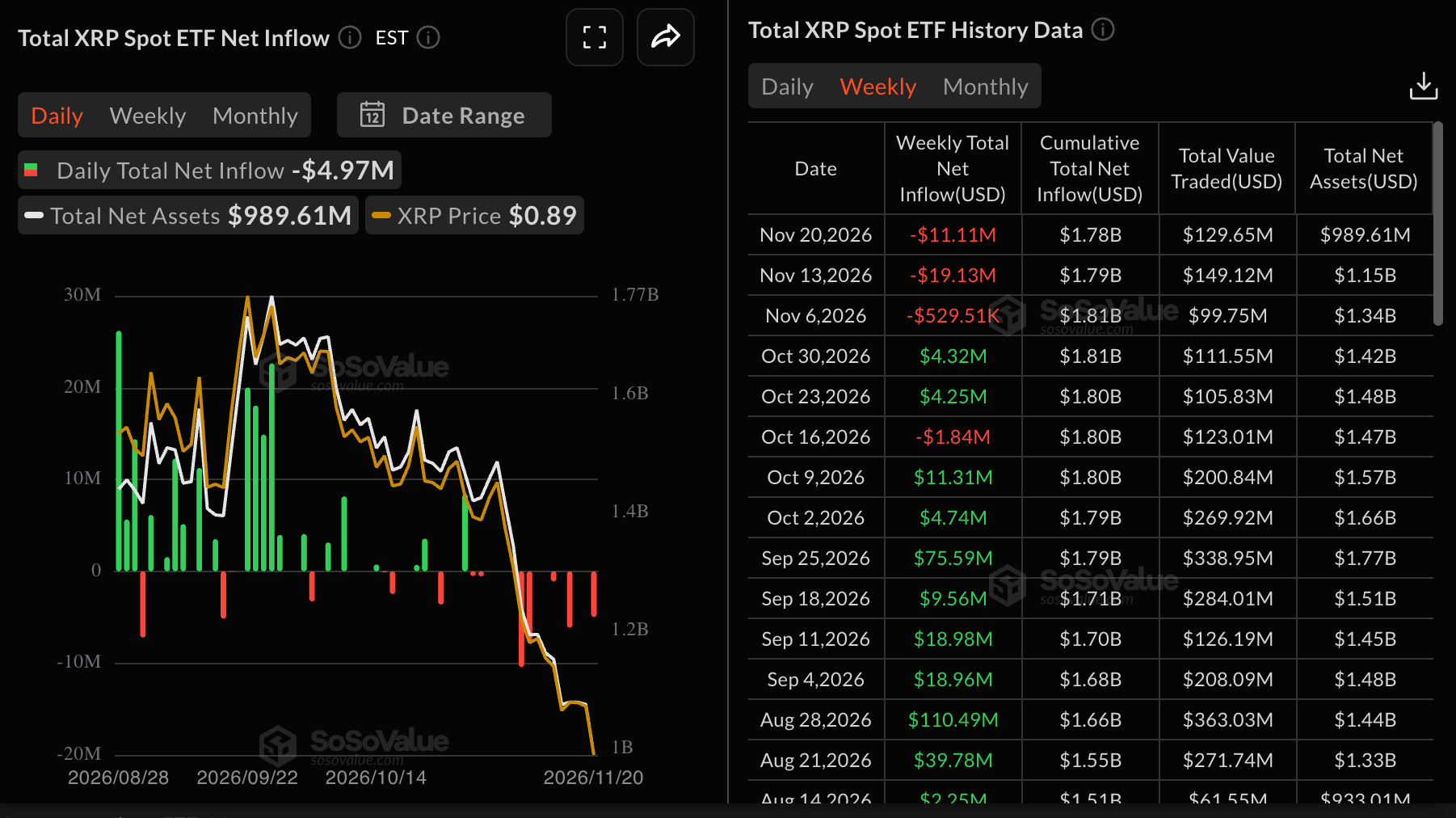
Institutional traders continue to withdraw from XRP spot Exchange-Traded Funds (ETFs). Withdrawals totalled roughly $11 million last week through Friday, extending the run of weekly outflows to three consecutive weeks.
The pressure extends beyond XRP spot ETFs: Bitcoin recorded outflows of $1.8 billion, while Ethereum saw $314 billion leave. Even so, XRP remains substantially undersubscribed relative to its peers. According to SoSoValue, cumulative inflows into XRP ETFs stand at $1.8 billion, with net assets under management below $1 billion.
By comparison, inflows into Bitcoin ETFs total $53 billion, alongside net assets of $71 million. For Ethereum ETFs, inflows amount to $11 billion and net assets under management stand at $8.6 billion.
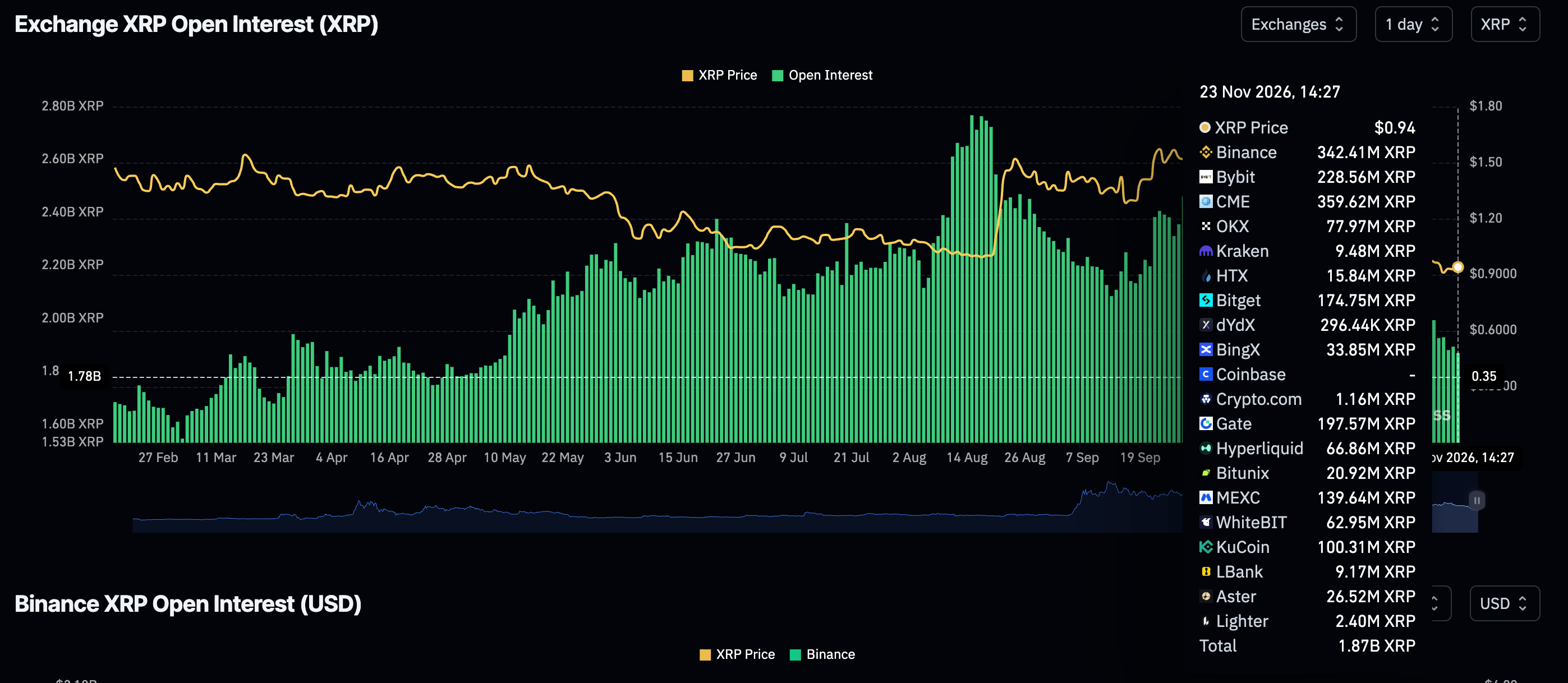
Selling pressure is also building in derivatives as traders adjust positions after the sell-off over recent weeks. On Monday, perpetual futures Open Interest (OI) is at 1.87 billion XRP, compared with 1.88 billion XRP the previous day. The broader decline from 2.36 billion on 8 November amounts to 21%, weakening retail demand. Should this trend persist, a downward move will likely remain the path of least resistance, increasing the possibility of a prolonged correction in XRP’s price.
Technical analysis: Can XRP mount a strong recovery?
Trading at $0.94, XRP continues to show a bearish short-term bias, with its price far below the key Exponential Moving Averages (EMAs). Dynamic resistance is stacked above it at the 50-day EMA of $1.16, the 100-day EMA of $1.23 and the 200-day EMA of $1.30. These levels reinforce the broader downtrend marked by a descending resistance trendline extending through the $1.19 area.
Momentum has improved slightly: the Moving Average Convergence Divergence (MACD) has only just edged into positive territory, while the Relative Strength Index (RSI) has climbed from oversold levels towards 31. However, these changes merely suggest consolidation in a market where the upside remains constrained.
The SuperTrend level near $1.09 presents the first resistance, followed by likely supply around the 50-day EMA at $1.16. Clearing that zone would bring the descending trendline barrier’s confluence with the $1.19 region into focus. Beyond it lie the 100-day EMA at $1.23 and the longer-term 200-day EMA near $1.30. The indicators provided do not identify clear support. As a result, the prevailing structure suggests rebounds towards these overhead resistance clusters are likely to attract selling unless the price regains and sustains a position above the mid-$1.10s.
(The technical analysis of this story was written with the help of an AI tool. Read more.)
Crypto ETFs: Frequently Asked Questions
Investors use an Exchange-Traded Fund (ETF) to obtain exposure to a particular asset. This investment vehicle or index follows the price of an underlying asset, but its scope can also extend to a basket of assets and sectors rather than a single holding. A Bitcoin ETF, for instance, follows the price of Bitcoin.
Yes. In October 2021, the US Securities & Exchange Commission approved the first Bitcoin futures ETF in the US. Approvals have been granted to a total of seven Bitcoin futures ETFs, while more than 20 await regulatory permission. According to the SEC, the cryptocurrency industry is new and vulnerable to manipulation. This is the reason it gives for delaying crypto-related futures ETFs over the last few years.
Yes. Several spot Bitcoin Exchange-Traded Funds received SEC approval for listing and trading in January 2024. This paved the way for institutional capital and mainstream investors to trade the leading cryptocurrency, a decision the industry welcomed as a game changer.
Exposure to a cryptocurrency without having to own it is the principal benefit of crypto ETFs, lowering the risks and costs of holding the asset. They also offer an easier learning curve and greater security for investors because the ETFs take responsibility for safeguarding the underlying holdings. The main drawback, however, is the absence of direct ownership, captured by the crypto saying, “not your keys, not your coins.” Fees charged by ETFs for active management can also increase the costs associated with holding crypto. Moreover, although ETFs reduce the risks involved in holding an asset, fluctuations in the underlying cryptocurrency’s price are still likely to feed through to the investment vehicle.
POPULAR ARTICLES
1Russian Rouble: Will It Weaken Gradually Against the US Dollar Into 2028? – Commerzbank2US Dollar: How are Fed rate hike bets supporting the outlook? - BBH3Silver Price Forecast: Can XAG/USD sustain its rebound of over 3% as bears remain in control?4Swiss Franc: Does UOB expect rangebound trading against US Dollar?5As the US Dollar recoups losses, the Canadian Dollar remains stuck at 19-month lows6Why are election risks capping the Polish Zloty’s upside? – Commerzbank7Ripple Price Forecast: XRP remains range-bound as retail and institutional capital flows out8British Pound: How does the BoE outlook curb downside risks? – BBH9Swiss Franc strengthens as investors stay wary following equity sell-off


Get Started!
Sign up and access the Global Markets in less than 3 minutes

Connect With Us












The information provided on this website is of a general nature only and does not constitute personal financial advice. Before acting on any information on this website, you should consider the suitability of the information in relation to your objectives, financial situation and needs. Investing in CFDs and FX Margin Contracts carries significant risks and is not suitable for all investors. You may lose more than your initial deposit. You do not own, or have, any interest in the underlying asset. We recommend that you seek independent advice and ensure you fully understand the risks involved before trading. It is important that you read and consider the disclosure document before you acquire any product listed on the website. The information and advertisements offered on this website are not intended for use by any person in any country or jurisdiction where such use would be contrary to local laws and regulations. The Products and Services offered on this website are not intended for residents of the United States, Malaysia and Thailand.
TMGM is authorized and regulated in various jurisdictions.
Trademax Australia Limited, trading as TMGM, is regulated by the Australian Securities and Investments Commission (ASIC), AFSL no. 436416 and is located at Level 28, One International Tower, 100 Barangaroo Avenue, 2000 Sydney, NSW Australia.
Email: support@tmgm.com.au
Trademax Global Limited, trading as TMGM, is authorized and regulated by the Vanuatu Financial Services Commission (VFSC), registration number 40356 and registered at 1276, Kumul Highway, Port Vila, Vanuatu, Republic of Vanuatu.
Email: support@tmgm.com
Trademax Global Markets (SE) Limited, trading as TMGM, is authorized and regulated by the Financial Services Authority (FSA) of Seychelles, with license number SD224. The company is registered at Office No 13, Providence Estate ABIS Centre, Mahe, Seychelles.
Email: support@tmgm.com
Trademax Global Markets (International) Pty Ltd, trading as TMGM, is authorized and regulated by the Financial Services Commission, Mauritius (FSC) with license no. GB22201012, and registered at 33, Edith Cavell Street C/o IQ EQ Fund Services (Mauritius) Ltd Port Louis, 11324 Mauritius.
Email: support@tmgm.com
Copyright © TMGM. All rights reserved