

Trading
Explore a wide range of markets with competitive pricing, deep liquidity, and advanced trading tools.
Learn More 
Platform
Trade seamlessly with TMGM's powerful platform, built for speed, precision, and a superior trading experience.
Learn More Trading Platform
Academy
Learn the fundamentals of trading with beginner-friendly resources, including guides, webinars, and market insights.
Learn More News & Analysis
Get real-time market updates and expert analysis to stay ahead of trading opportunities
Learn More News & Analysis
About
Learn what sets TMGM apart — our global presence, regulatory strength, and commitment to innovation in trading.
Learn More Why Choose TMGM
Sponsorship
USD/CAD Price Forecast: Further gains supported by debate over size of Fed’s next rate hike
- 1.4213 is within reach as USD/CAD surges. Weaker oil prices weigh on the Canadian Dollar.
- Concerns over aggressive Fed tightening lift the US Dollar.
- October US CPI figures again exceeded expectations.
Multiple headwinds keep the Canadian Dollar (CAD) lagging behind the US Dollar (USD). Hopes for a United States (US)-Iran deal have pushed oil prices lower. Alongside renewed concerns about aggressive monetary tightening by the Federal Reserve (Fed), this has lifted USD/CAD.
USD/CAD has gained 0.17% at the time of writing. Trading near 1.4213, the pair is at its highest in over three weeks. Meanwhile, the US Dollar Index (DXY) stands near 102.37, up 0.15%. The index measures the Greenback against six major currencies.

Almost 18% has been wiped off the WTI Oil price, taking it from recent highs of 104.03 to around $85.35. Falling oil prices reduce the attraction of currencies from net energy-exporting economies such as Canada.
25 or 50bps: Fed December hike viewed as virtually certain
A December rate increase is now effectively assured in TD Securities’ view. The bank says the “strong upside surprise in the US CPI makes a December hike all but certain,” reiterating that “today's data certainly seals a Dec rate hike by the Fed.” Attention has turned to the scale of the move. Strategists observe that “after Waller's speech, the debate has now shifted to whether the FOMC will go 25 or 50bps,” with Governor Waller’s remarks before the CPI release bringing the potential need for a “catch-up” move into sharper focus. TD Securities says the question is now whether the Fed should deliver a “catch-up 50bps rate hike in December, or whether to maintain course with a 25bps rate increase and provide strong guidance toward a potential January follow-through.” Its current preference remains unchanged: “we still favor a 25bp hike with a rising risk of another hike in January.”
USD/CAD Technical Analysis: 1.4212 With a Bullish Near-Term Bias
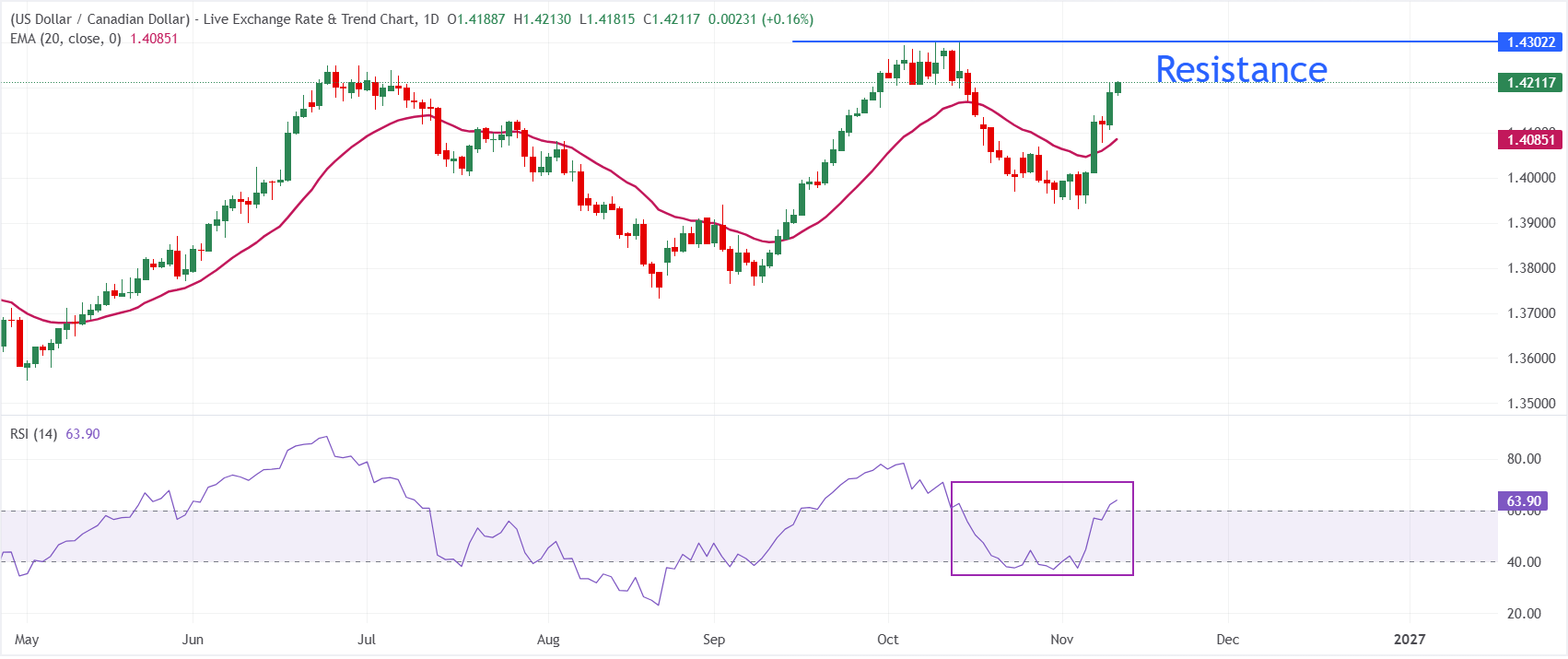
1.4212 is the USD/CAD level on the daily chart. The near-term outlook remains bullish as the pair advances above its 20-day Exponential Moving Average (EMA), now providing support at 1.4085. At 63.9, the Relative Strength Index (RSI) remains in positive territory but has yet to indicate overbought conditions. Buyers therefore retain the upper hand, although consolidation remains possible following the recent recovery.
The 1.4210 area provides the nearest downside support and serves as a nearby pivot. Below it, the 20-day EMA at 1.4085 could attract renewed dip-buying if the pair pulls back. This dataset shows no significant technical resistance immediately above current levels. Attention therefore centres on whether buyers can hold these support levels and sustain the broader uptrend.
(The technical analysis of this story was written with the help of an AI tool. Know more.)
US Dollar: Key Questions
Over 88% of global foreign exchange turnover involves the US Dollar (USD), according to 2022 data. That represents an average of $6.6 trillion in daily transactions, making it the world’s most actively traded currency. The USD is the official currency of the United States of America. In a significant number of other countries, it also circulates alongside local banknotes as the ‘de facto’ currency. After the Second World War, the USD replaced the British Pound as the world’s reserve currency. Gold backed the US Dollar for most of its history, until the Bretton Woods Agreement in 1971 brought the Gold Standard to an end.
Monetary policy is the single biggest influence on the US Dollar’s value. The Federal Reserve (Fed) sets that policy under a dual mandate: maintaining price stability by controlling inflation and promoting full employment. Interest rate adjustments are its main means of pursuing both objectives. Inflation above the Fed’s 2% target, with prices rising too rapidly, prompts the central bank to increase rates, supporting the USD. Conversely, inflation below 2% or an excessively high unemployment rate may lead the Fed to cut rates, putting pressure on the Greenback.
In exceptional circumstances, the Federal Reserve can create additional Dollars through quantitative easing (QE). The policy substantially expands credit flows when the financial system is stalled. QE is an unconventional measure used when lending has dried up because banks fear counterparty defaults and will not lend to one another. It serves as a last resort when interest rate cuts alone are unlikely to deliver the required outcome. During the Great Financial Crisis in 2008, the Fed used it as its preferred response to the credit crunch. Under QE, the Fed prints additional Dollars to purchase US government bonds, mainly from financial institutions. The policy generally weakens the US Dollar.
The reverse of quantitative easing is quantitative tightening (QT). Under QT, the Federal Reserve ceases bond purchases from financial institutions and allows its existing bonds to mature without reinvesting the principal in new purchases. This generally supports the US Dollar.
POPULAR ARTICLES
1Near $53: Silver Price Forecast as XAG/USD jumps despite higher US bond yields2Euro steady against Canadian Dollar as oil prices soften3US Dollar Index gains as Fed expectations are repriced – Deutsche Bank4British Pound retreats despite hawkish BoE; weak Yen appears to limit downside5US Treasuries: Markets price in further hikes, driving bear flattening – TD Securities6Dow Jones futures rally as AI earnings and easing geopolitical risks lift market sentiment7Euro: ECB ready for new tools, Knot signals – Rabobank8December rate hike: Expectations of a Federal Reserve increase strengthen – Commerzbank9Q4 likely to bring faster German growth: ECB’s Nagel


Get Started!
Sign up and access the Global Markets in less than 3 minutes

Connect With Us












The information provided on this website is of a general nature only and does not constitute personal financial advice. Before acting on any information on this website, you should consider the suitability of the information in relation to your objectives, financial situation and needs. Investing in CFDs and FX Margin Contracts carries significant risks and is not suitable for all investors. You may lose more than your initial deposit. You do not own, or have, any interest in the underlying asset. We recommend that you seek independent advice and ensure you fully understand the risks involved before trading. It is important that you read and consider the disclosure document before you acquire any product listed on the website. The information and advertisements offered on this website are not intended for use by any person in any country or jurisdiction where such use would be contrary to local laws and regulations. The Products and Services offered on this website are not intended for residents of the United States, Malaysia and Thailand.
TMGM is authorized and regulated in various jurisdictions.
Trademax Australia Limited, trading as TMGM, is regulated by the Australian Securities and Investments Commission (ASIC), AFSL no. 436416 and is located at Level 28, One International Tower, 100 Barangaroo Avenue, 2000 Sydney, NSW Australia.
Email: support@tmgm.com.au
Trademax Global Limited, trading as TMGM, is authorized and regulated by the Vanuatu Financial Services Commission (VFSC), registration number 40356 and registered at 1276, Kumul Highway, Port Vila, Vanuatu, Republic of Vanuatu.
Email: support@tmgm.com
Trademax Global Markets (SE) Limited, trading as TMGM, is authorized and regulated by the Financial Services Authority (FSA) of Seychelles, with license number SD224. The company is registered at Office No 13, Providence Estate ABIS Centre, Mahe, Seychelles.
Email: support@tmgm.com
Trademax Global Markets (International) Pty Ltd, trading as TMGM, is authorized and regulated by the Financial Services Commission, Mauritius (FSC) with license no. GB22201012, and registered at 33, Edith Cavell Street C/o IQ EQ Fund Services (Mauritius) Ltd Port Louis, 11324 Mauritius.
Email: support@tmgm.com
Copyright © TMGM. All rights reserved