




Tokyo can still afford to defend the Japanese Yen, just not for very long
- USD/JPY trades short of 164.00 after last week's high stopped shy of the handle by a rounding error, holding the strongest Dollar ground against Japan's currency since 1986.
- April and May brought a record 11.73 trillion Yen defence, close to double the largest previous effort, and the level it defended gave way inside six weeks.
- Friday stacks the Bank of Japan decision, the quarterly Outlook Report and the finance ministry's monthly intervention tally onto a single session.
The Japanese Yen trades a little firmer on Monday, with USD/JPY down 0.05% and sitting short of 164.00 after last week's high stalled a hundredth of a Yen beneath the figure. Markets have spent a fortnight waiting for Tokyo to do something about it and have started asking whether Japan simply cannot afford to. The answer is more interesting than that, and worse.
The money was never the constraint
Japan holds foreign exchange reserves of roughly $1.3 trillion, second in the world only to China. Around $1.1 trillion of that sits in foreign securities, mostly United States government debt, which cannot be liquidated at speed without disturbing the bond market and crystallising losses. The practical war chest is the foreign currency held on deposit at the central bank and at other central banks, somewhere between $150 billion and $180 billion, sitting on top of a standing swap line with the Federal Reserve worth up to $120 billion more.
At the typical size of a single operation, one strategist's arithmetic earlier this year put that at roughly 32 more interventions. Nobody serious thinks Japan is running out of Dollars. What Tokyo is running out of is something less negotiable.
What the record defence actually bought
Across April and May the finance ministry deployed 11.73 trillion Yen, about $73 billion, after the exchange rate breached 160.00. That is close to twice the size of any previous Japanese operation, and it was executed into a market with no supporting catalyst behind it. Within six weeks the pair had reclaimed the level it was spent defending. It now trades roughly four Yen beyond it.
There is a second ceiling that gets less attention. The International Monetary Fund (IMF) classifies an exchange rate as freely floating only where official intervention stays within a small number of short episodes across a rolling window, and Japan spent most of that allowance in the spring. Analysts counting the budget in early May reckoned two more operations were available before November without the country losing the label. That is a currency defence rationed by classification rather than by cash, which is a very different constraint and a far harder one to top up.
Monday supplied the evidence
The clearest read on what an intervention would achieve arrived without one. Crude Oil fell close to 9% on the stand-down between Washington and Tehran, which for an economy importing nearly all of its energy is about the largest single-day improvement in the terms of trade available. The Yen responded by gaining less than a tenth of a Yen against the Dollar.
That is the structural problem in one session. The interest rate differential that used to explain the overwhelming majority of the moves in this pair has narrowed by roughly 40 basis points from its cycle low, and the Yen has depreciated something like 15% anyway, with rising domestic inflation expectations filling the space the rate gap vacated. Verbal warnings have not stopped either, and one landed as recently as Friday. What has stopped is anybody pricing them.
The week is built for an ambush
The reason Tokyo has been quiet is likely tactical rather than fiscal. A standalone operation is short-lived by common consent, so the effective moment is one where Yen-buying pressure already exists, and the calendar supplies exactly one. The Federal Reserve decides Wednesday at 18:00 GMT, with consensus on a fourth consecutive hold at 3.75%, no Summary of Economic Projections attached, and a live minority priced for a hike.
Japan's own data begins Thursday at 23:30 GMT with July Tokyo inflation, the core measure seen at 1.7% YoY from 1.6%, alongside unemployment at 2.5% and June retail trade at 23:50 GMT expected to slow sharply to 3.1% YoY from 5.3%. Friday then delivers the Bank of Japan (BoJ), where consensus looks for a hold at 1.00% with the Outlook Report at 03:00 GMT and the press conference at 06:30 GMT. Most watchers place the next increase in December, though reporting suggests the board is open to moving faster precisely because the currency is adding to price risk. The finance ministry's intervention tally for the month to 29 July publishes the same day, so Friday is also when the market learns whether Tokyo has already been in.
Japanese Yen levels
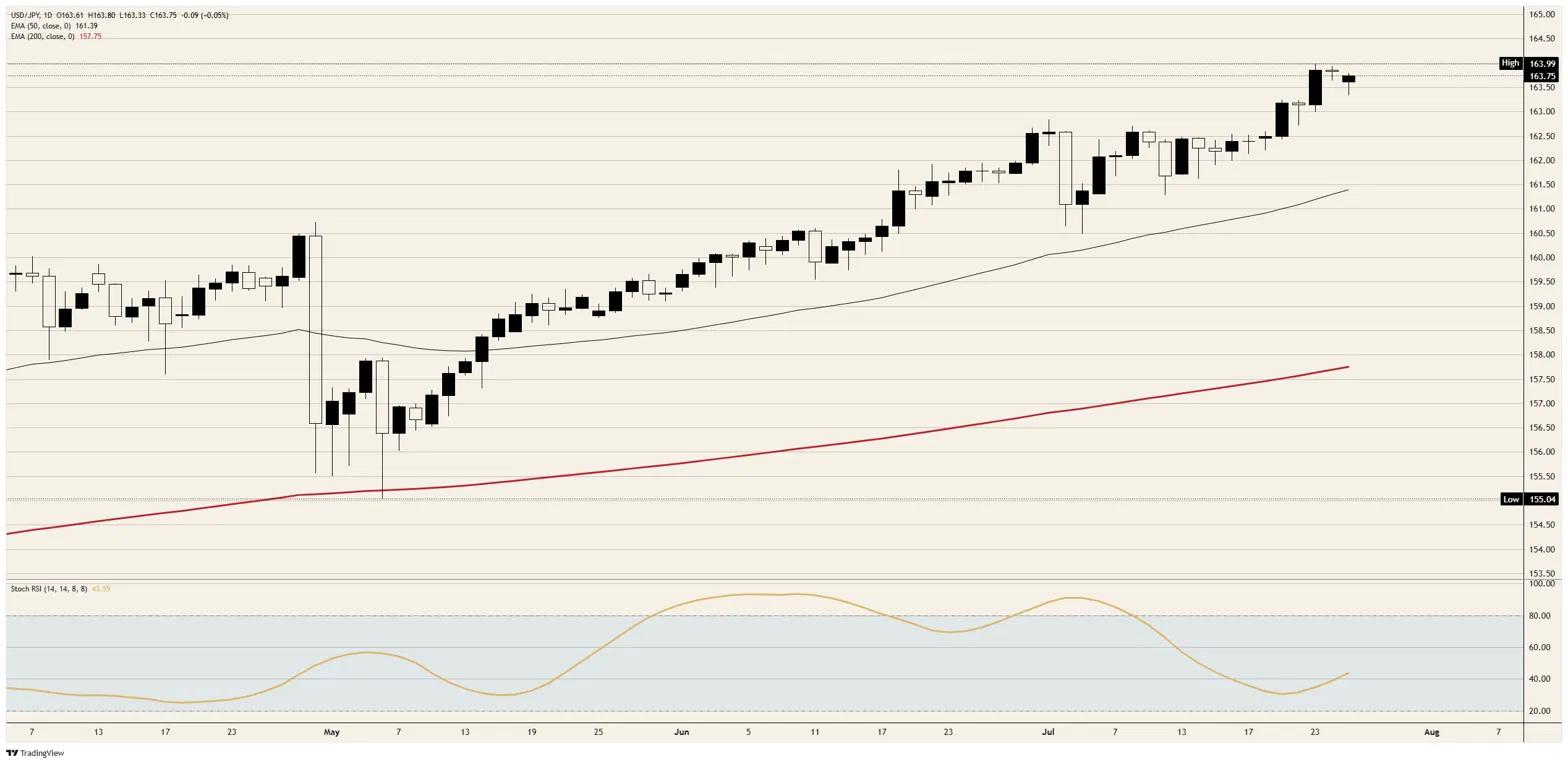
Upside: 164.00 is the only level that matters, and above it there is no modern chart structure at all, which leaves 164.50 and 165.00 as the round numbers standing in for resistance.
Downside: 163.00 is the first real shelf, with 162.50 beneath it and the rising 50-day Exponential Moving Average (EMA) near 161.50 marking the trend line proper.
Bias: Bullish above 163.00. The risk to that call is neither technical nor economic but official, and it is concentrated in the forty-eight hours after the Federal Reserve reports on Wednesday evening.
USD/JPY daily chart
Japanese Yen FAQs
The Japanese Yen (JPY) is one of the world’s most traded currencies. Its value is broadly determined by the performance of the Japanese economy, but more specifically by the Bank of Japan’s policy, the differential between Japanese and US bond yields, or risk sentiment among traders, among other factors.
One of the Bank of Japan’s mandates is currency control, so its moves are key for the Yen. The BoJ has directly intervened in currency markets sometimes, generally to lower the value of the Yen, although it refrains from doing it often due to political concerns of its main trading partners. The BoJ ultra-loose monetary policy between 2013 and 2024 caused the Yen to depreciate against its main currency peers due to an increasing policy divergence between the Bank of Japan and other main central banks. More recently, the gradually unwinding of this ultra-loose policy has given some support to the Yen.
Over the last decade, the BoJ’s stance of sticking to ultra-loose monetary policy has led to a widening policy divergence with other central banks, particularly with the US Federal Reserve. This supported a widening of the differential between the 10-year US and Japanese bonds, which favored the US Dollar against the Japanese Yen. The BoJ decision in 2024 to gradually abandon the ultra-loose policy, coupled with interest-rate cuts in other major central banks, is narrowing this differential.
The Japanese Yen is often seen as a safe-haven investment. This means that in times of market stress, investors are more likely to put their money in the Japanese currency due to its supposed reliability and stability. Turbulent times are likely to strengthen the Yen’s value against other currencies seen as more risky to invest in.













