Key Takeaways
- Swing trading focuses on capturing price movements over several days within broader market trends, providing opportunities for consistent profits with reduced screen time when following a disciplined strategy and defined risk parameters.
- Establishing a solid foundation involves mastering essential charting techniques and indicators, setting clear entry and exit points, and employing stop-loss orders alongside real-time profit and loss (P&L) monitoring to ensure decisions are rule-based rather than emotional.
- Effective swing trading methods include trend-following, support and resistance analysis, price channels such as Bollinger Bands, volatility strategies based on the Average True Range (ATR), and Fibonacci retracements, all tailored to the specific asset and validated by volume analysis.
- Discipline and risk management——including position sizing, favorable risk-to-reward ratios, predefined stop-losses, and maintaining a trading journal——are critical to preserving capital and minimizing emotion-driven errors.
- While swing trading can be profitable, it is not guaranteed; results depend on the quality of your strategy, prevailing market conditions, and effective risk controls. Expect variability and prioritize ongoing strategy testing and refinement.

What Is Swing Trading? Building Your Swing Trading Strategies Foundation
Before aiming for significant gains, it’s essential to build a robust foundation in swing trading. This includes understanding and applying key concepts such as utilising Technical Analysis tools, interpreting chart patterns, and implementing sound risk management techniques. These skills enable you to grasp market momentum and make informed decisions to maximise trading potential.
Swing trading involves identifying medium-term price movements within longer-term trends. Unlike day trading strategies, which focus solely on intraday price action, swing trading aims to capitalise on price retracements and rallies by entering and exiting positions to secure consistent incremental profits. Mastering these fundamentals prepares you to explore advanced swing trading techniques and sophisticated technical indicators.
Before advancing, learn how to set stop-loss orders tailored for swing trading to protect your capital and limit downside risk. Additionally, tracking your trades’ profits and losses in real time enhances portfolio oversight and decision-making.
Effective Swing Trading Strategies & Techniques
A variety of swing trading strategies exist, each suited to different trading styles, risk tolerances, and market environments. Define your trading objectives and preferred holding periods—short-term or longer-term—when selecting your approach. Also, consider the asset class, as some indicators effective in Forex may not be optimal for stocks or indices due to differing market dynamics.
Key strategies to consider include:
Trend-Following Swing Trading Strategy
Trend-following aims to identify prevailing market directions and enter positions accordingly. Utilizing charts and technical indicators such as Moving Average Convergence Divergence (MACD) and trendlines, traders assess market sentiment to decide on long or short entries by identifying whether the asset is trending upward, downward, or sideways. Direction and momentum are crucial to maximising profit potential.
Example: In early 2023, EUR/USD consistently traded above its 50-day moving average, signaling a clear uptrend. Traders who initiated long positions during this bullish phase benefited from sustained momentum.
Why It Works: Trend-following aligns trades with dominant market conditions. Markets often exhibit sustained directional trends driven by macroeconomic data, monetary policy shifts, or geopolitical developments. Trading with the trend reduces exposure to countertrend risks, enhancing the probability of profitable outcomes.
Support & and Resistance Levels for Swing Trading Strategies
Also called breakout trading, this strategy focuses on identifying critical support and resistance zones and understanding trader psychology. By analysing market structure, chart patterns, and trendlines, traders can act decisively when prices approach key levels, optimising entry and exit points. Successfully navigating these zones enables capitalisation on breakouts and potential trend reversals.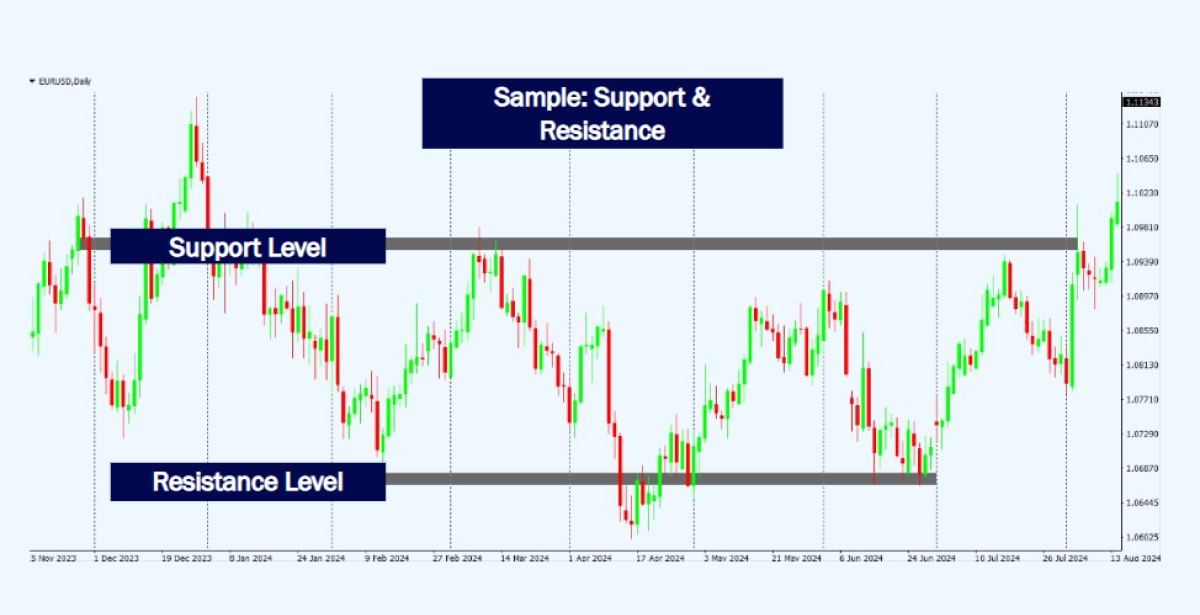
Example: In early 2023, gold (XAU/USD) repeatedly encountered resistance near $2,000 per ounce. Traders monitoring this level identified opportunities when the price broke above this barrier, profiting from subsequent sharp moves.
Why It Works: Support and resistance levels reflect collective market psychology. Prices often stall at these points due to trader expectations. A breakout signals a shift in market sentiment, frequently triggering significant price movements. Recognising these psychological price levels helps traders anticipate and exploit market shifts effectively.
Price Channels: A Key Swing Trading Indicator
Price channels, including Bollinger Bands, are essential tools for identifying optimal buy and sell zones on price charts. By analysing trend direction within these channels, traders can gauge momentum. Price channels are often combined with other indicators like chart patterns or MACD to corroborate signals in technical analysis.
Bollinger Bands interpretation: the upper band represents resistance linked to recent highs, the lower band connects recent lows, and the middle band indicates the moving average acting as support.
A common approach is buying near the lower band and selling near the upper band, with stop-loss orders to manage risk.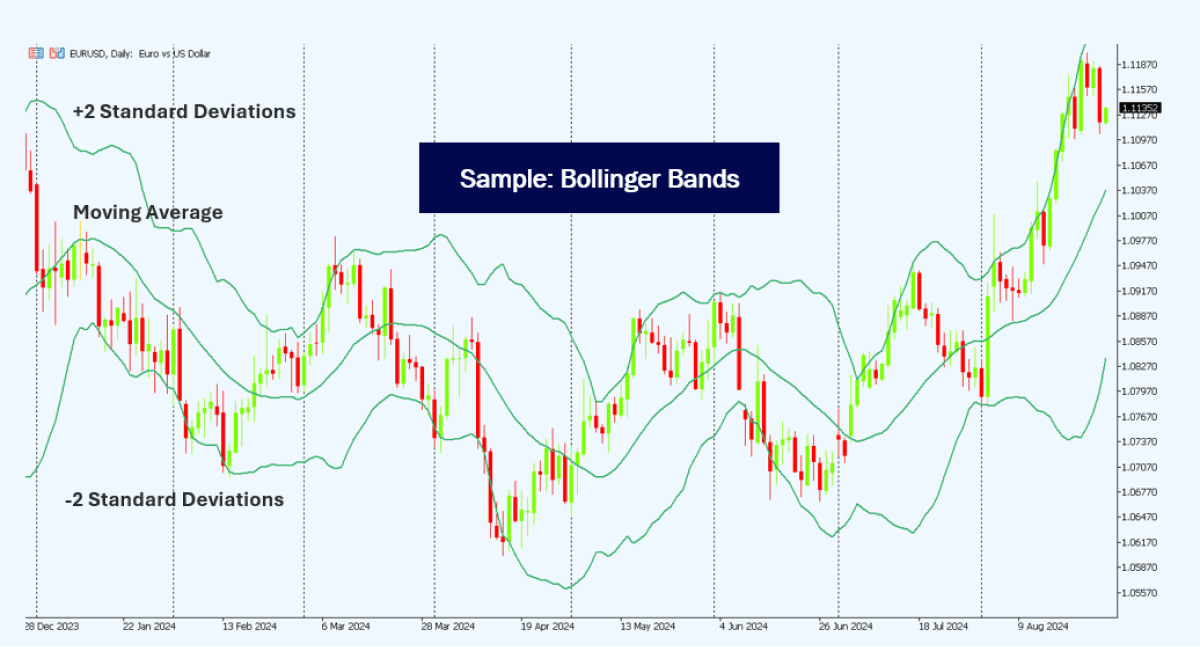
Example: In mid-2022, Ethereum (ETH/USD) consistently traded within defined Bollinger Bands. Traders profited by buying near the lower band (oversold conditions) and selling near the upper band (overbought conditions).
Why It Works: Price channels offer a systematic way to identify overbought and oversold market states. By clearly illustrating volatility and typical trading ranges, they enable traders to exploit recurring patterns for consistent gains. These visual tools also help reduce emotional bias by providing objective trading criteria.
Volatility Trading Strategies with ATR – One of the Best Indicators for Swing Trading
Volatility is a crucial consideration in swing trading. Rather than targeting exact highs and lows, traders aim to profit from price fluctuations within the asset’s range.
The Average True Range (ATR) is a widely used volatility indicator measuring the average price movement per candlestick over a set period, commonly 14 days, weeks, or months. An ATR rising above its moving average often signals strong price momentum and potential breakout opportunities. Traders can adjust ATR periods to suit their preferred trading timeframe and volatility profile.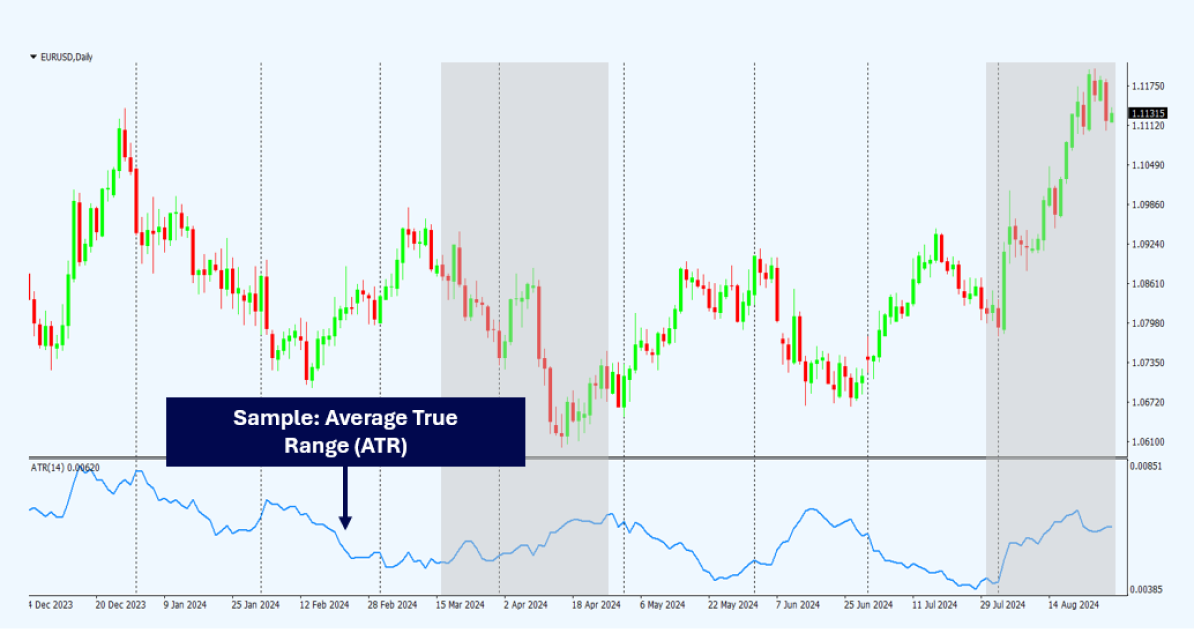
Example: Bitcoin (BTC/USD) has exhibited significant volatility since 2020——note how Crypto CFDs amplify exposure to these swings, as reflected in ATR values. Traders monitoring ATR fluctuations identified profitable entry points during heightened volatility, maximising returns from rapid price movements.
Why It Works: Volatility trading excels during periods of market uncertainty, economic data releases, or major news events when price swings intensify. By quantifying volatility, traders can strategically position to capture substantial profits in dynamic conditions, making this approach well-suited for short-term trading.
Fibonacci Retracement: A Core Swing Trading Strategy
Fibonacci Retracement is a powerful tool for identifying potential support and resistance levels. By analysing significant price swings and overlaying Fibonacci ratios, traders can anticipate likely retracement points to time entries and exits. Common retracement levels include 38.2%, 50%, and 61.8%, indicating where price may reverse or consolidate.
The following chart illustrates a Fibonacci retracement, showing price reversals as it approaches resistance and support zones (highlighted in red).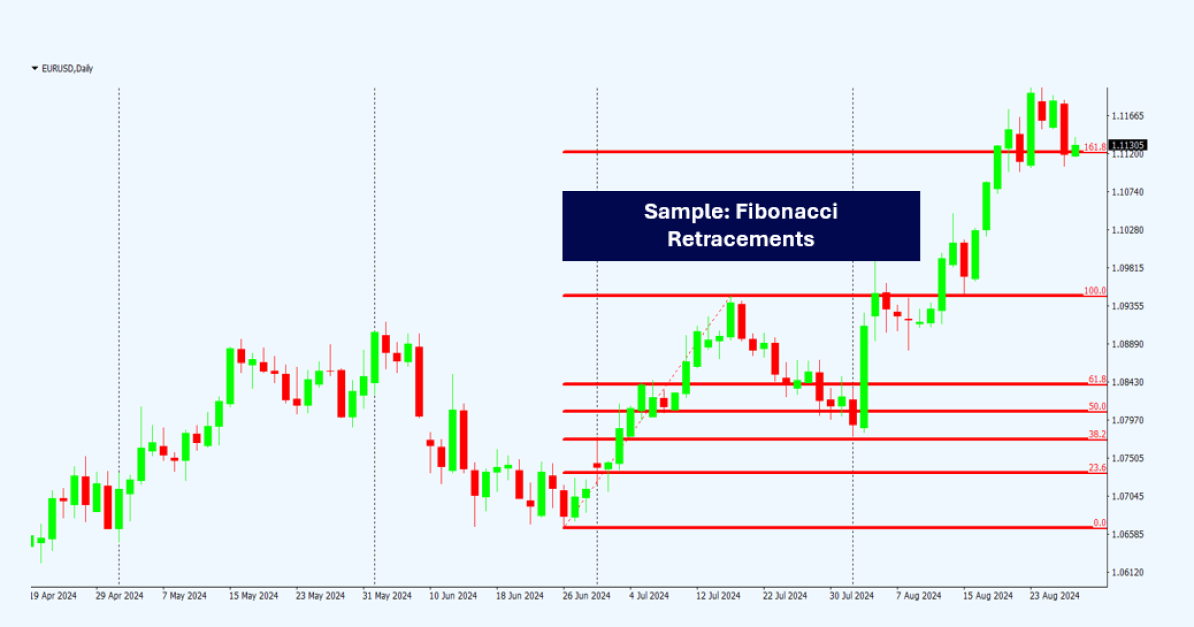
Example: In late 2022, GBP/USD rallied significantly before retracing to the 50% Fibonacci level. Traders entering long positions at this support level profited as the price rebounded.
Why It Works: Fibonacci retracements are effective because they reflect common market psychology and behaviour. Widely used by traders globally, these levels often become self-fulfilling, increasing their reliability as key decision points.
Discipline & and Risk Management in Swing Trading Strategies
Discipline is vital for executing a successful trading plan. Given the relatively short holding periods in swing trading, maintaining a clear plan with defined entry and exit rules is critical. This focus helps minimise emotional decision-making. Profit and loss potential also depends on asset volatility, making the use of risk-to-reward ratios and stop-loss orders essential for capital preservation and balanced risk management.
Example: A trader identifies a swing trade opportunity in Gold (XAU/USD), targeting a $1,200 profit while risking $300, yielding a favorable Risk-to-Reward Ratio (RRR) of 1:4. By placing an appropriate stop-loss, the trader limits downside risk and protects capital from significant adverse moves.
Why It Works: Strong risk management and discipline support trading longevity and profitability. A structured approach reduces emotional trading and safeguards capital during market downturns. Clear risk-to-reward parameters help contain losses, enabling consistent gains and sustainable trading over time.
R/R Ratio Illustration
Consider a trade with a potential profit of $2,000 but a possible loss of $500 if unsuccessful.
- Risk (Potential Loss): $500
- Reward (Potential Profit): $2,000
- Risk-to-Reward Ratio: 1:4 (risking $1 to potentially gain $4)
In this case, the ratio indicates the reward significantly exceeds the risk, making the trade attractive. Conversely, less favorable ratios like 1:1 or 2:1 imply higher risk for lower reward, reducing appeal.
Incorporating risk-to-reward ratios into your strategy facilitates informed decision-making and better downside risk management. Pairing swing trading strategies with stop-loss orders ensures automatic trade exits at predetermined levels, protecting capital.
Maintaining a trading journal is also recommended to track trades, stay focused, and evaluate performance. Whether using traditional methods or digital tools, documenting strategies, results, and insights helps refine your approach and improve outcomes over time.
Conclusion: Is Swing Trading Profitable?
Swing trading offers a flexible and tailored method to capture short-term market momentum. By developing a comprehensive swing trading plan and mastering the techniques outlined here, you can create a strategy aligned with your trading style and financial objectives.
With discipline and a strategy suited to your goals, swing trading can be highly effective across various asset classes and technical tools.
As with all trading and investing, ongoing education, research, and experimentation are essential for long-term success. Staying informed and committed will help you unlock swing trading’s potential and work toward your financial ambitions.
Our team is ready to support you at every stage. Whether you’re new to trading or expanding your portfolio, we provide the expertise and assistance necessary to help you succeed and grow.
Remember: Trading CFDs involves risks——learn how margin trading works and apply appropriate risk management—so that with the right strategies and mindset, trading can be a rewarding experience.
Ready to Get Started?
Sign up now and access global markets in under three minutes.
Start Trading or Try Our Demo Account